
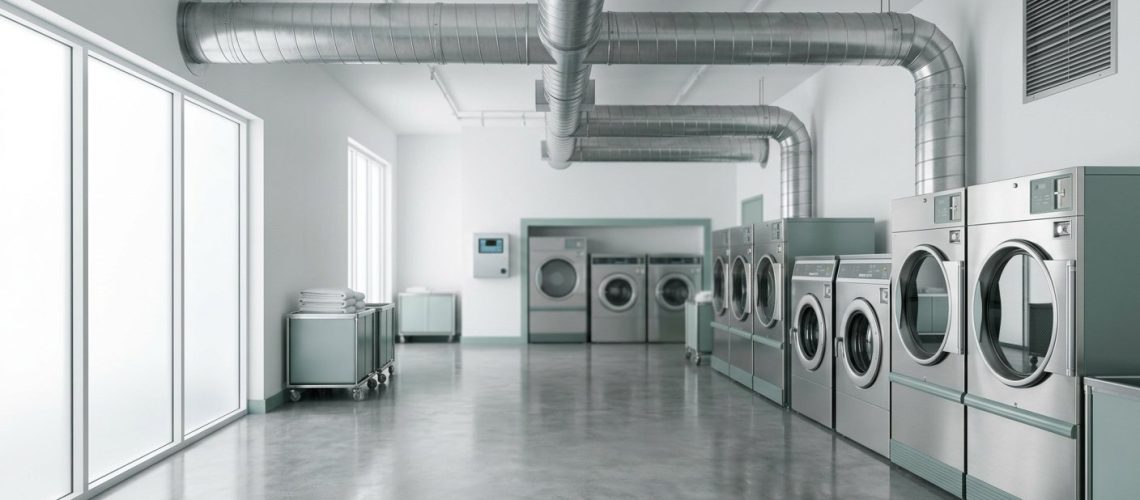
Poor ventilation is one of the most common—and most costly—oversights in commercial laundry equipment installation. In South Florida’s humid subtropical environment, inadequate exhaust and airflow don’t just reduce equipment efficiency; they accelerate lint buildup, strain dryer motors, create moisture problems in walls and ceilings, and create real fire hazards. Whether you’re outfitting a hotel laundry room in Fort Lauderdale, installing an on-premises laundry at a Boca Raton assisted living facility, or planning a new laundromat in Miami, getting ventilation right from the start protects your equipment investment and your building.
This guide covers what South Florida facility managers and business owners need to understand about commercial dryer ventilation—from duct design basics to moisture management considerations unique to this region.
Why Ventilation Is a Business-Critical Issue
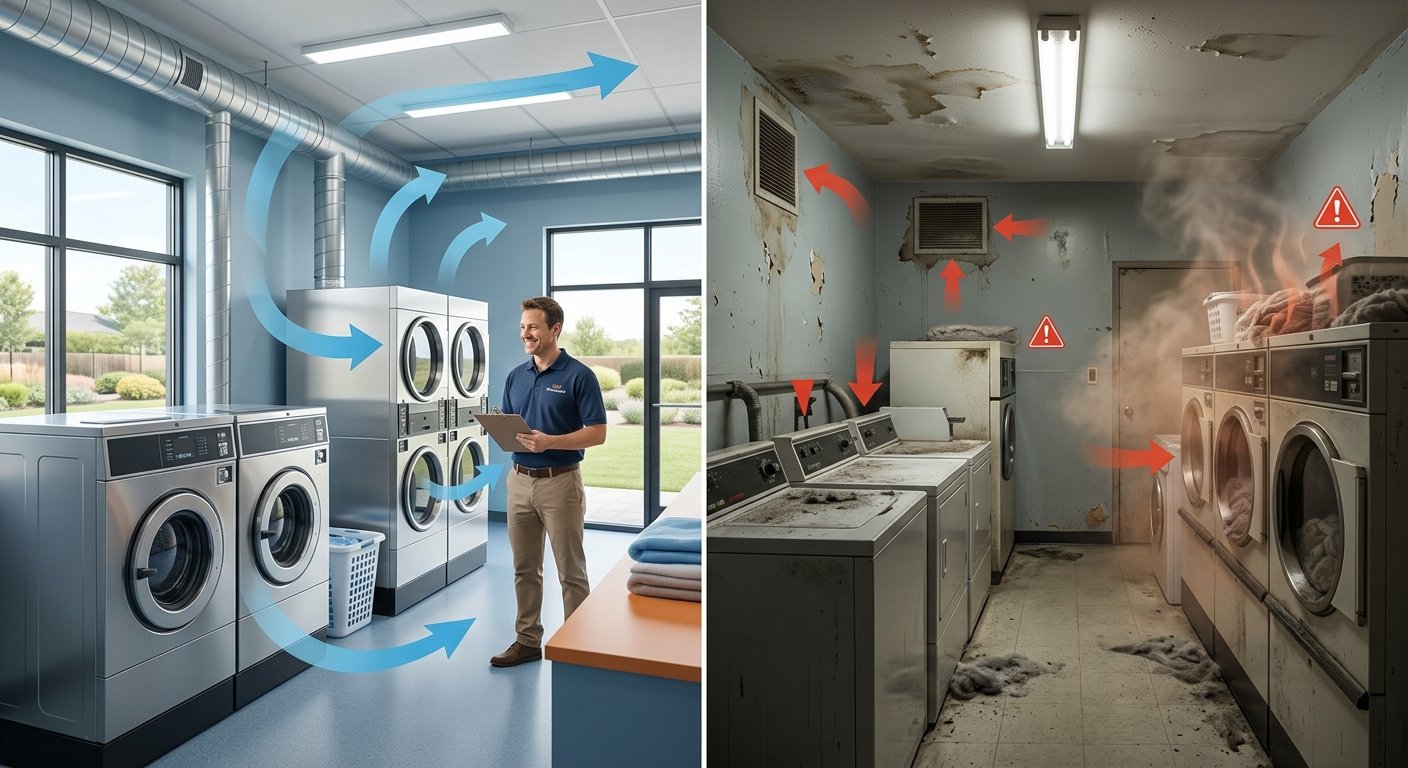
Most facility managers think about commercial laundry equipment in terms of wash capacity, cycle times, and energy costs. Ventilation often gets treated as an afterthought—something the contractor will handle. That approach regularly creates expensive problems down the line.
Commercial dryers expel large volumes of hot, moisture-laden air on every cycle. In a properly designed system, that air is directed outside the building through a duct network sized to handle the airflow without resistance. When the duct run is too long, uses too many elbows, or is undersized for the equipment, back-pressure builds up. The dryer works harder, cycle times increase, lint accumulates in the ductwork, and energy costs rise. In South Florida’s year-round heat, an overworked dryer motor also generates additional heat load in an already warm mechanical space.
The National Fire Protection Association consistently identifies lint accumulation in dryer exhaust systems as a leading cause of commercial laundry fires. Proper duct design and a regular cleaning schedule are not optional—they’re fundamental operating requirements for any responsible facility.
Key Ventilation Concepts for Commercial Dryers
Exhaust Duct Sizing and Static Pressure
Commercial dryers are rated for specific airflow volumes, measured in cubic feet per minute (CFM). The exhaust duct must be sized to move that air volume without exceeding the dryer manufacturer’s maximum allowable static pressure. When static pressure is too high—usually because the duct is undersized or the run is too long—the dryer’s exhaust fan can’t move air efficiently. This directly translates to longer dry times, higher energy consumption, and accelerated component wear.
As a general rule, each 90-degree elbow in a duct run adds equivalent resistance equal to several feet of straight duct. In practice, this means the physical duct length and the number of bends must both be factored into the design. A professional commercial laundry equipment supplier will calculate total equivalent length before specifying duct diameter and layout.
Makeup Air: The Often-Missed Component
For every cubic foot of air a dryer exhausts, a cubic foot of replacement air must enter the space. This is makeup air. In a sealed or tightly constructed laundry room without a dedicated makeup air supply, the dryer essentially fights against negative pressure—pulling air through door gaps, hallways, and unintended pathways. The result is reduced dryer performance and potential pressure problems throughout the building.
South Florida buildings, particularly newer construction designed for energy efficiency and hurricane resistance, are often well-sealed. That makes dedicated makeup air supply even more important for commercial laundry spaces. This is something that needs to be addressed during the design phase of any commercial laundry equipment installation—not after equipment is already running.
Condensing vs. Vented Dryers
Traditional commercial dryers exhaust moisture and lint-laden air directly to the outside. Condensing dryers, by contrast, capture moisture internally and drain it away, eliminating the need for an exhaust duct run entirely. In situations where exterior venting is difficult or impossible—upper-floor hotel laundry rooms, interior building spaces, or locations where duct runs would be excessively long—condensing dryers can be a practical solution.
The tradeoff is that condensing dryers typically have longer cycle times than comparable vented units and require access to a drain. They also add heat and humidity to the laundry room, which in South Florida means additional cooling load on your HVAC system. Whether a condensing or vented dryer makes more sense depends on your specific building layout, throughput requirements, and overall mechanical system design.
South Florida-Specific Ventilation Considerations
Humidity and Moisture Management
South Florida’s humidity levels are consistently high compared to most of the country, with indoor relative humidity often becoming a management challenge in commercial laundry spaces. When warm, moist exhaust air contacts cooler surfaces—or when a laundry room lacks adequate cooling—condensation can form on walls, ceilings, and equipment surfaces. Over time, this creates conditions favorable for mold and mildew growth, which is a significant concern in healthcare, hospitality, and multi-housing environments where indoor air quality matters.
According to the U.S. Environmental Protection Agency, controlling moisture is the most effective strategy for preventing mold growth in commercial buildings. In the context of laundry operations, that means properly exhausting dryer moisture to the exterior, maintaining adequate room cooling, and ensuring ductwork is airtight to prevent moisture infiltration into wall cavities.
Duct Termination and Wind Considerations
In coastal South Florida communities—from Miami Beach to Palm Beach—wind-driven rain and salt air present specific challenges for exhaust duct terminations. Duct terminations need proper backdraft dampers to prevent wind from pushing back into the duct and must be positioned to avoid direct rain exposure. In hurricane-prone areas, termination caps and dampers should also be rated for high-wind conditions.
Salt air can accelerate corrosion in duct components, particularly at exterior terminations. Specifying corrosion-resistant materials at these points adds modest upfront cost but reduces maintenance issues significantly over the life of the installation.
Rooftop vs. Wall Termination
In multi-story facilities—hotels, apartment buildings, healthcare facilities—routing exhaust ductwork to an exterior wall on the same floor is often simpler than running it to the roof. However, wall terminations need careful positioning to avoid exhausting near HVAC intake points, windows, or pedestrian areas. Rooftop terminations eliminate these concerns but require longer duct runs and more complex penetrations through the building envelope. Both approaches work well when properly designed; the right choice depends on the building’s specific layout and mechanical room location.
Ventilation Planning for Different Facility Types
Hotels and Hospitality Properties
Hotel laundry rooms are often located in basement or interior spaces, making exhaust duct routing a genuine design challenge. Hotels also run laundry operations for extended hours, which amplifies any ventilation deficiencies. If you’re evaluating hotel laundry equipment options, involve your mechanical engineer and equipment supplier early in the planning process to ensure the exhaust system is sized for your anticipated load—not just for a single dryer, but for the full bank of dryers operating simultaneously.
Laundromats
Vended laundry locations with multiple commercial dryers running simultaneously require careful attention to aggregate exhaust airflow and makeup air supply. A well-designed laundromat ventilation system can actually improve customer comfort by managing heat and humidity in the space—a meaningful consideration for customer retention in South Florida’s warm months. For guidance on commercial laundry equipment selection for new laundromat builds, proper ventilation planning should be part of your initial layout conversation.
Healthcare and Multi-Housing
Healthcare facilities and apartment communities often have on-premises laundry (OPL) operations in shared mechanical spaces. Lint containment and fire-code compliance are especially important in these environments. Duct cleaning schedules should be formalized and documented, and lint traps should be inspected regularly as part of a standard maintenance protocol.
Maintenance: Keeping Your Ventilation System Performing
Even a well-designed exhaust system degrades over time without proper maintenance. Lint accumulates in ductwork, dampers stick, and duct connections can loosen. A practical maintenance approach includes:
- Cleaning lint from accessible duct sections quarterly, or more frequently in high-volume operations
- Inspecting and cleaning exterior termination caps and backdraft dampers annually
- Verifying makeup air supply is unobstructed and functioning
- Monitoring dryer cycle times—increasing dry times often indicate a ventilation restriction before any other symptom appears
- Using factory-authorized service for dryer maintenance to ensure exhaust components are properly checked during routine visits
As a factory-authorized commercial laundry equipment service provider, we include exhaust system assessment as part of our preventive maintenance visits—because ventilation problems and equipment problems are directly connected.
Frequently Asked Questions
How long can a commercial dryer exhaust duct run be?
Maximum duct length depends on the specific dryer model, duct diameter, and number of elbows in the run. Most manufacturers publish equivalent length specifications in their installation documentation. In practice, commercial laundry installations often require larger duct diameters than residential standards to accommodate longer runs. Always consult manufacturer specs and your equipment supplier during planning.
Do commercial dryers require a separate makeup air supply?
Yes, in virtually all commercial laundry installations. Without adequate makeup air, the dryer exhausts against negative pressure, reducing efficiency and potentially creating pressure imbalances in the building. A mechanical engineer or experienced equipment supplier should assess makeup air needs as part of any installation plan.
Can I add more dryers to an existing exhaust duct system?
Not without assessing whether the existing ductwork can handle the increased airflow. Adding dryers to an undersized exhaust system creates the back-pressure problems described above and can create fire hazards from lint accumulation. Any expansion of your dryer capacity should include an evaluation of the exhaust system’s current capacity.
How often should commercial dryer exhaust ducts be professionally cleaned?
In high-volume operations such as hotels or laundromats, professional duct cleaning is typically recommended annually at minimum, with quarterly inspection of accessible sections. Lower-volume OPL installations may require less frequent service, but regular inspection remains important.
Are condensing dryers code-compliant alternatives to vented dryers in Florida?
Generally yes, but specific code requirements vary by jurisdiction and occupancy type. Consult with your local building department and a licensed contractor familiar with South Florida commercial construction requirements before finalizing your equipment selection.
Work with a Supplier Who Understands the Full Picture
At Commercial Laundry Equipment Company, we’ve been helping South Florida businesses design, install, and maintain commercial laundry operations for over 55 years. As a second-generation, family-owned business serving West Palm Beach, Boca Raton, Fort Lauderdale, Miami, and communities throughout Palm Beach, Broward, Miami-Dade, and Monroe Counties, we understand that ventilation, equipment selection, and long-term service support are all part of the same conversation.
If you’re planning a new installation, expanding an existing operation, or dealing with performance issues that may be ventilation-related, we’re ready to help you work through the details. Contact our team at (561) 848-0054 to discuss your facility’s specific needs.