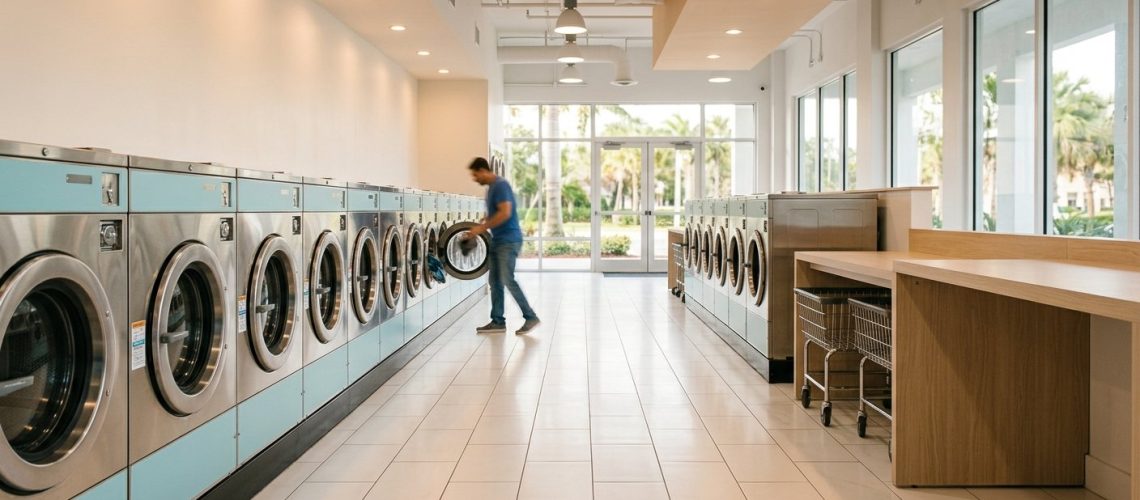
Laundromats consistently rank among the most recession-resistant small businesses in the United States. People need clean clothes regardless of economic conditions, and in South Florida—where dense multi-housing communities, seasonal tourism, and a transient workforce create steady demand—the fundamentals for vended laundry investment remain strong heading into 2026.
But “recession-resistant” doesn’t mean effortless. A laundromat’s profitability depends heavily on equipment selection, location, proper sizing, and the quality of your service partnership. This guide addresses what South Florida investors need to understand before committing capital—and how to avoid the mistakes that erode margins for years after opening day.
Why South Florida Remains a Strong Market in 2026
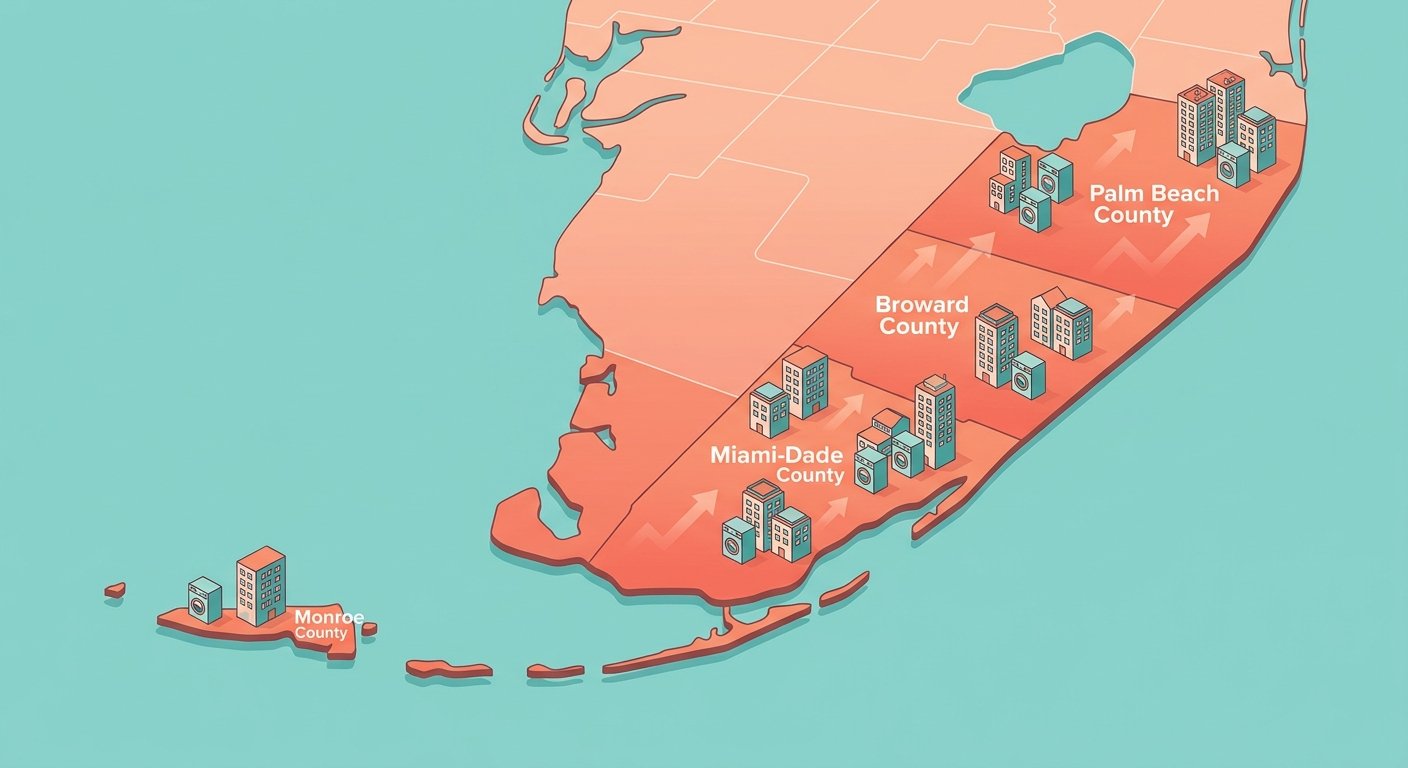
Palm Beach, Broward, Miami-Dade, and Monroe counties share a common characteristic: a significant portion of residents live in apartments, condos, and rental units without in-unit laundry. According to the U.S. Census Bureau’s American Community Survey, Florida consistently shows higher renter-occupied housing rates in urban corridors than the national average—and renters are the core laundromat customer base.
Beyond residential demand, South Florida’s hospitality sector—hotels, short-term rentals, resort communities—creates ancillary demand in neighborhoods where laundromats serve both guests and employees. Add in the region’s year-round population of retirees, seasonal workers, and new arrivals, and you have a market that doesn’t experience the seasonal dips common in northern markets.
That said, competition exists. The opportunity is real, but it rewards operators who invest in quality equipment, modern payment systems, and consistent maintenance—not those looking for the lowest-cost path to ownership.
Understanding Commercial Laundry Equipment Prices
One of the first questions prospective laundromat investors ask is: what does equipment actually cost? Commercial laundry equipment prices vary significantly based on capacity, brand, configuration, and whether you’re purchasing new or refurbished units.
For a new vended laundromat, a typical equipment package—including a mix of top-load and front-load washers, stack dryers, and payment systems—can range widely depending on the number of machines and capacity mix. Larger-capacity machines generally offer better revenue per square foot, which is why most experienced operators prioritize 20–40 lb. front-load washers over smaller residential-style equipment.
New vs. Refurbished Commercial Laundry Equipment
Refurbished commercial laundry equipment can be a viable option for investors with tighter budgets, but it requires careful evaluation. The key questions are: who refurbished it, what parts were replaced, and is it backed by a warranty and service support?
Equipment refurbished and sold through a reputable commercial laundry equipment dealer—one that uses OEM (original equipment manufacturer) parts and can provide local service—is a fundamentally different proposition than used machines purchased at auction with no service history. At Commercial Laundry Equipment Company, we’ve seen investors save money upfront on unverified used equipment only to spend significantly more on repairs within the first year of operation.
If you’re considering refurbished units, work with a factory-authorized dealer who can certify the condition of the machines and provide a clear parts and service commitment.
Equipment Selection: What Actually Drives Laundromat Revenue
The equipment mix you choose directly determines your revenue potential, utility costs, and customer experience. These aren’t abstract variables—they show up in your monthly numbers.
High-Extraction Washers
Modern front-load commercial washers—particularly high-G-force extractors—remove significantly more water from laundry than older machines. Higher extraction means shorter dryer cycles, lower gas or electric costs, and faster customer turnaround. In a busy South Florida laundromat, faster cycles mean higher revenue per machine per day. This is why G-force extraction rates matter when comparing equipment specifications.
Dryer Capacity and Configuration
A common sizing mistake is under-investing in dryer capacity relative to washer capacity. The general rule is that you need dryer capacity to match or exceed your wash capacity, accounting for cycle time differences. Stack dryers are a space-efficient option for South Florida locations where retail square footage is expensive.
Speed Queen Commercial Laundry Equipment
Among the brands we supply and service, Speed Queen commercial laundry equipment is a consistent performer in vended laundromat environments. Speed Queen’s commercial line is purpose-built for high-volume, coin- and card-operated use, with construction standards and serviceability that translate into lower long-term maintenance costs. For South Florida operators who can’t afford extended downtime, the reliability profile of commercial-grade equipment matters more than upfront price.
Commercial Laundry Equipment Financing Options
Most laundromat investors finance at least a portion of their equipment. Commercial laundry equipment financing is available through several channels, each with different terms, requirements, and implications for cash flow.
- Equipment financing loans: Secured by the equipment itself, these typically offer fixed terms and predictable monthly payments. The equipment serves as collateral, which often makes approval more accessible for new business owners.
- SBA loans: The U.S. Small Business Administration’s 7(a) and 504 loan programs can be used for laundromat equipment and build-out costs. These programs often offer longer terms and competitive rates for qualified borrowers.
- Manufacturer or dealer financing programs: Some equipment manufacturers offer financing programs through commercial lending partners. These can be worth comparing against independent financing options.
- Leasing: Equipment leasing preserves capital and can simplify upgrades, though total cost over time is typically higher than purchasing. It may make sense depending on your growth strategy and tax situation.
Before committing to any financing structure, consult with a CPA familiar with small business equipment investments. The depreciation and tax treatment of commercial laundry equipment can meaningfully affect your net cost of ownership.
What to Look for in a Commercial Laundry Equipment Dealer
Your equipment dealer relationship doesn’t end at the sale. In vended laundry, downtime is lost revenue—and lost revenue compounds. A machine that’s out of service for a week costs you customer goodwill in addition to direct income.
When evaluating a commercial laundry equipment dealer in South Florida, ask these questions:
- Are they factory-authorized for the brands they sell?
- Do they stock OEM parts locally, or do you wait for shipping from a warehouse?
- Do they have technicians in your service area who know these specific machines?
- Can they provide references from other laundromat operators in the region?
- Do they offer a service agreement, or is every call a separate transaction?
Commercial Laundry Equipment Company has been serving South Florida for over 55 years as a second-generation, family-owned business. We’re factory-authorized for the brands we sell, and we maintain local parts inventory and service technicians across Palm Beach, Broward, Miami-Dade, and Monroe counties. That local presence matters when a machine goes down on a Saturday afternoon in Fort Lauderdale or Boca Raton.
For a broader overview of our commercial equipment capabilities, visit our commercial laundry equipment page.
South Florida-Specific Considerations
Not every laundromat guide accounts for regional variables. South Florida presents a few worth noting:
- Humidity and corrosion: Equipment in South Florida faces higher ambient humidity than in northern markets. This affects maintenance schedules and makes proper ventilation in your equipment room a functional priority, not just a comfort issue.
- Water quality: South Florida water chemistry varies by municipality and can affect washer components and detergent performance over time. A good equipment dealer will factor this into recommendations.
- Utility infrastructure: Gas versus electric dryer decisions depend on local utility rates and available infrastructure. In some South Florida locations, natural gas availability and pricing make gas dryers the clear economic choice; in others, electric is more practical. This is a site-specific analysis.
- Permitting and code requirements: Local municipalities across Palm Beach, Broward, and Miami-Dade counties have their own permitting processes for commercial laundry installations. Work with licensed contractors for build-out, and confirm equipment specifications meet local code requirements before purchasing.
Frequently Asked Questions
How many machines do I need for a new laundromat?
Machine count depends on your location’s customer volume, square footage, and target revenue. Most new South Florida laundromats start with 20–40 machines in a mix of capacities. An experienced equipment dealer can help model a layout based on your specific space and market.
Is refurbished commercial laundry equipment a good investment?
It can be, provided the equipment was refurbished using OEM parts by a qualified technician and is backed by a warranty and local service support. Unverified used equipment from auctions or unestablished sellers carries significant risk and is generally not advisable for a primary laundromat investment.
What is the typical lifespan of commercial laundry equipment?
Well-maintained commercial washers and dryers from reputable manufacturers are engineered for 15–25 years of service life in vended environments, depending on usage volume and maintenance quality. According to the Coin Laundry Association, regular preventive maintenance is one of the most significant factors in extending equipment life and controlling operational costs.
How does commercial laundry equipment financing work for a new business?
New business owners typically have access to equipment financing loans secured by the machinery, SBA loan programs, or manufacturer-affiliated financing. Terms and approval requirements vary. Most lenders will want to see a business plan, personal credit history, and documentation of the location lease or purchase.
Do I need a service contract for my laundromat equipment?
A service agreement with a factory-authorized dealer is strongly advisable. It provides predictable maintenance costs, priority service response, and access to OEM parts—all of which reduce downtime and protect your revenue stream.
Ready to Plan Your South Florida Laundromat?
Entering the laundromat business in South Florida with the right equipment, the right sizing, and the right service partner gives you a meaningful operational advantage over competitors who cut corners at the start. The decisions you make on day one—brand selection, machine mix, dealer relationship—affect your profitability for the next decade or more.
Commercial Laundry Equipment Company has guided laundromat investors, property owners, and operators across West Palm Beach, Miami, Fort Lauderdale, Delray Beach, Boynton Beach, and throughout South Florida for over 55 years. We’re here to help you make informed decisions, not just sell equipment.
Contact us at (561) 848-0054 to discuss your project, or explore our full range of commercial laundry equipment solutions to get started.