
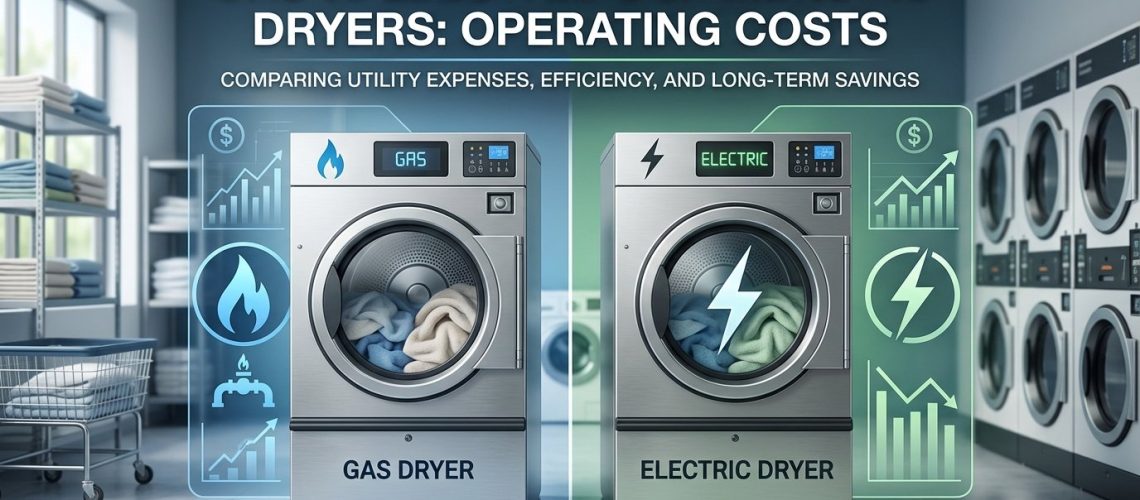
The question hits every commercial laundry decision-maker’s desk eventually: should you install gas or electric dryers? While the equipment price tags might look similar, the operating costs tell dramatically different stories. Over a typical dryer’s 10-15 year lifespan, fuel costs can dwarf your initial investment by five or even ten times, making this one of the most financially consequential decisions in your facility planning.
Understanding commercial dryer operating costs requires looking beyond your utility rates. Infrastructure requirements, throughput capacity, maintenance patterns, and even your building’s physical configuration all play roles in determining which fuel type delivers better value for your specific operation.
The Energy Consumption Reality
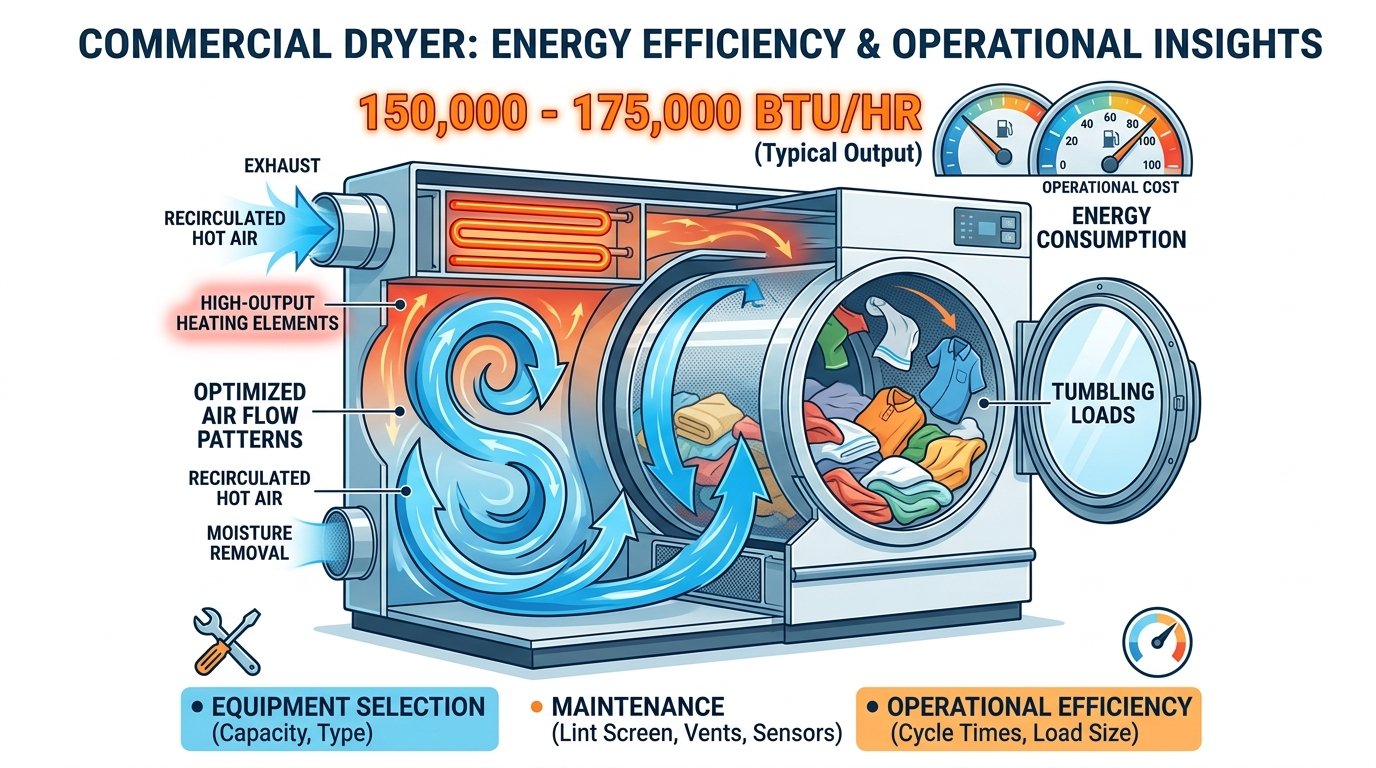
Commercial dryers are energy-intensive by nature. They generate high heat while moving large volumes of air through tumbling textiles—a process that consumes substantial power regardless of fuel source. A typical 50-pound capacity commercial dryer runs at approximately 150,000-175,000 BTU input for gas models, while electric equivalents pull 40-50 kilowatts.
Here’s where the math gets interesting. Natural gas delivers significantly more BTUs per dollar than electricity in most markets, including South Florida. As of 2026, commercial natural gas rates in the region average $12-15 per thousand cubic feet, while commercial electric rates run $0.10-0.14 per kilowatt-hour depending on your provider and demand charges.
When you convert these rates to equivalent thermal energy, natural gas typically costs 60-75% less than electricity for the same drying capacity. That advantage compounds with every load, every shift, every day your dryers operate.
Real-World Operating Cost Comparison
Let’s examine actual commercial dryer operating costs using a 50-pound capacity dryer running 8 hours daily, five days weekly—a moderate schedule for many hotel and multi-housing operations.
Gas Dryer Annual Operating Costs
A gas commercial dryer averaging 35 minutes per cycle at 150,000 BTU consumption uses approximately 87,500 BTU per load. Running 12-14 loads daily equals roughly 1.2 million BTU consumed per day, or about 12 therms. At $1.30 per therm (current South Florida commercial average), daily gas costs run approximately $15.60, translating to $4,056 annually for this moderate-use scenario.
Electric Dryer Annual Operating Costs
The equivalent electric dryer pulls 45 kilowatts during operation. That same 35-minute cycle consumes 26.25 kWh per load. Those 12-14 daily loads require 315-367 kWh daily. At $0.12 per kWh, you’re looking at $37.80-44.00 in daily electric costs, or $9,828-11,440 annually.
The difference? Gas dryers cost $5,772-7,384 less per year to operate in this scenario—and this represents moderate usage. High-volume operations like laundromats, hospitals, or large hotels running dryers 12-16 hours daily see proportionally larger gaps.
Beyond the BTU: Hidden Cost Factors
Commercial laundry utility costs extend beyond simple fuel consumption calculations. Several additional factors influence your total cost of ownership.
Demand Charges and Power Factor
Electric dryers contribute to demand charges—fees based on your peak power consumption during billing periods. Adding multiple electric dryers can push you into higher demand tiers, increasing costs across your entire facility. Gas equipment doesn’t trigger these electrical demand penalties, though you’ll face gas connection and meter fees.
Drying Speed and Throughput
Gas dryers typically heat faster and maintain more consistent temperatures than electric models, often completing cycles 5-10% quicker. This throughput advantage means processing more pounds per hour, potentially allowing you to meet demand with fewer machines. Faster turns also mean reduced labor costs—your staff spends less time managing each load.
Installation and Infrastructure Costs
Here’s where gas vs electric commercial dryers calculations become property-specific. Electric dryers require substantial electrical service—208V or 480V three-phase power with appropriate amperage capacity. Upgrading electrical panels and running heavy-gauge wiring can cost $3,000-8,000 per dryer location in retrofit situations.
Gas dryers need natural gas lines, proper venting for combustion exhaust, and fresh air makeup systems. If your building lacks gas service, bringing in a gas line might cost $10,000-50,000+ depending on distance from the main. However, once installed, that infrastructure serves all your gas appliances.
For new construction or facilities already equipped with both utilities, installation costs typically favor electric dryers slightly—gas connections and venting add $800-1,500 per dryer versus electric hookups.
The ROI Timeline Question
Gas dryer ROI calculations should account for both the infrastructure investment and ongoing savings. If you’re installing gas service specifically for dryers, that upfront cost extends your payback period significantly.
Consider a five-dryer installation in an existing building:
Scenario 1: Building has natural gas service
Additional gas infrastructure cost: $7,500
Annual operating savings vs. electric: $28,860-36,920
Simple payback period: 2.5-3.1 months
Scenario 2: Natural gas service required
Gas line installation: $25,000
Gas dryer infrastructure: $7,500
Total additional investment: $32,500
Annual operating savings vs. electric: $28,860-36,920
Simple payback period: 10.6-13.5 months
Even when major gas infrastructure investment is required, payback typically occurs within 12-18 months for moderate-to-high volume operations. After that, savings flow directly to your bottom line year after year.
South Florida Considerations
Our regional utility landscape influences the gas versus electric decision. Florida Power & Light, Duke Energy, and municipal utilities serve different areas with varying rate structures. Commercial rates have increased 18-23% since 2023, making operating cost analysis more critical than ever.
Natural gas availability varies significantly across South Florida. Miami-Dade, Broward, and parts of Palm Beach County have extensive natural gas infrastructure. However, some coastal areas, barrier islands, and certain municipalities lack gas service entirely, making electric dryers the only practical option regardless of operating costs.
Building codes in South Florida require robust ventilation systems. Gas dryers produce combustion byproducts requiring dedicated exhaust venting separate from lint exhaust. Makeup air requirements for gas dryer installations can be substantial—you’re exhausting conditioned air and must replace it, adding modest cooling costs to your calculations. Electric dryers only exhaust lint-laden air without combustion concerns.
Maintenance and Longevity Factors
Commercial dryer operating costs should include maintenance expectations. Gas dryers have additional components—burners, igniters, flame sensors, gas valves—that electric models lack. These parts require periodic service and eventual replacement.
However, gas dryers often experience less wear on heating elements compared to electric models. Electric heating coils cycle on and off under high load, eventually fatiguing. Gas burners, while requiring maintenance, typically prove durable when properly serviced.
Both fuel types require regular lint system cleaning, drum roller maintenance, and belt replacement. The critical difference lies in service expertise. Gas dryer service requires technicians trained in both laundry equipment and commercial gas appliance safety—a more specialized skill set that’s essential for safe, compliant operation.
When Electric Makes Sense
Despite significant operating cost advantages, gas dryers aren’t always the right answer. Electric dryers prove optimal in several scenarios:
- No gas service available: If natural gas infrastructure doesn’t exist and installation costs are prohibitive, electric is your practical choice
- Low-volume operations: Facilities running just a few loads weekly may never recoup gas infrastructure investment
- Space-constrained locations: Electric dryers can be simpler to install in tight spaces where gas venting and makeup air become complicated
- Specific code restrictions: Some buildings have restrictions on gas appliance installation due to historical preservation, condo bylaws, or other regulations
- Stacked configurations: When vertical space is your only option, electric stack dryers offer configurations not available in gas
Making Your Decision
Evaluating gas vs electric commercial dryers requires gathering specific information about your operation:
- Document your volume: Estimate daily pounds processed or loads completed to calculate actual fuel consumption
- Verify utility availability and rates: Confirm both gas and electric service capabilities and obtain current commercial rates including all fees
- Assess infrastructure needs: Have a qualified contractor evaluate installation requirements for both options
- Calculate true ROI: Include infrastructure costs, operating expenses, and maintenance expectations over a 10-year timeline
- Plan for growth: Consider how volume might increase—gas dryers scale more cost-effectively in high-volume scenarios
Frequently Asked Questions
How much does it cost to run a commercial gas dryer per load?
A typical 50-pound gas commercial dryer costs approximately $1.10-1.30 per load in fuel costs based on current South Florida natural gas rates and a 35-minute cycle time. Actual costs vary with cycle length, dryer efficiency, and specific gas rates.
Are gas dryers cheaper to operate than electric in Florida?
Yes, significantly. Gas commercial dryers typically cost 60-75% less to operate per load than electric dryers in South Florida’s utility market. Annual savings of $5,000-7,500 per dryer are common in moderate-use operations, with higher-volume facilities seeing proportionally greater savings.
What is the payback period for commercial gas dryers?
If natural gas service exists, payback occurs in 2-4 months for moderate-volume operations. When gas infrastructure installation is required, payback typically extends to 10-18 months depending on installation costs and usage volume. After payback, savings continue throughout the equipment’s 10-15 year lifespan.
Do gas dryers dry faster than electric?
Generally yes. Gas commercial dryers heat more quickly and maintain more consistent temperatures, often completing cycles 5-10% faster than comparable electric models. This throughput advantage improves productivity and can reduce labor costs in high-volume operations.
Partner with Experience
Choosing between gas and electric commercial dryers shapes your operating costs for the next decade or more. The decision requires analyzing your specific facility, usage patterns, utility infrastructure, and business projections—not just comparing equipment specifications.
We’ve guided South Florida businesses through these calculations for over 55 years, helping hotels, hospitals, laundromats, and multi-housing properties optimize their commercial laundry investments. Our team evaluates your actual requirements, provides detailed operating cost projections based on your utility rates, and ensures proper installation regardless of fuel type.
Ready to analyze which dryer type delivers better value for your operation? Contact our commercial laundry specialists for a detailed operating cost analysis specific to your facility and usage patterns. We’ll help you make the choice that strengthens your bottom line for years to come.