
The sticker price on commercial laundry equipment tells only part of the story. Every month, businesses across South Florida discover this truth the hard way when their “budget-friendly” washers and dryers begin revealing their true cost through unexpected breakdowns, excessive utility bills, and operational headaches that impact their bottom line.
Understanding the total cost of ownership laundry equipment requires looking beyond the initial purchase price. The cheapest option upfront often becomes the most expensive investment over time, and this reality affects everyone from hotel managers to laundromat owners who need reliable equipment to run their operations smoothly.
1. Excessive Energy Consumption
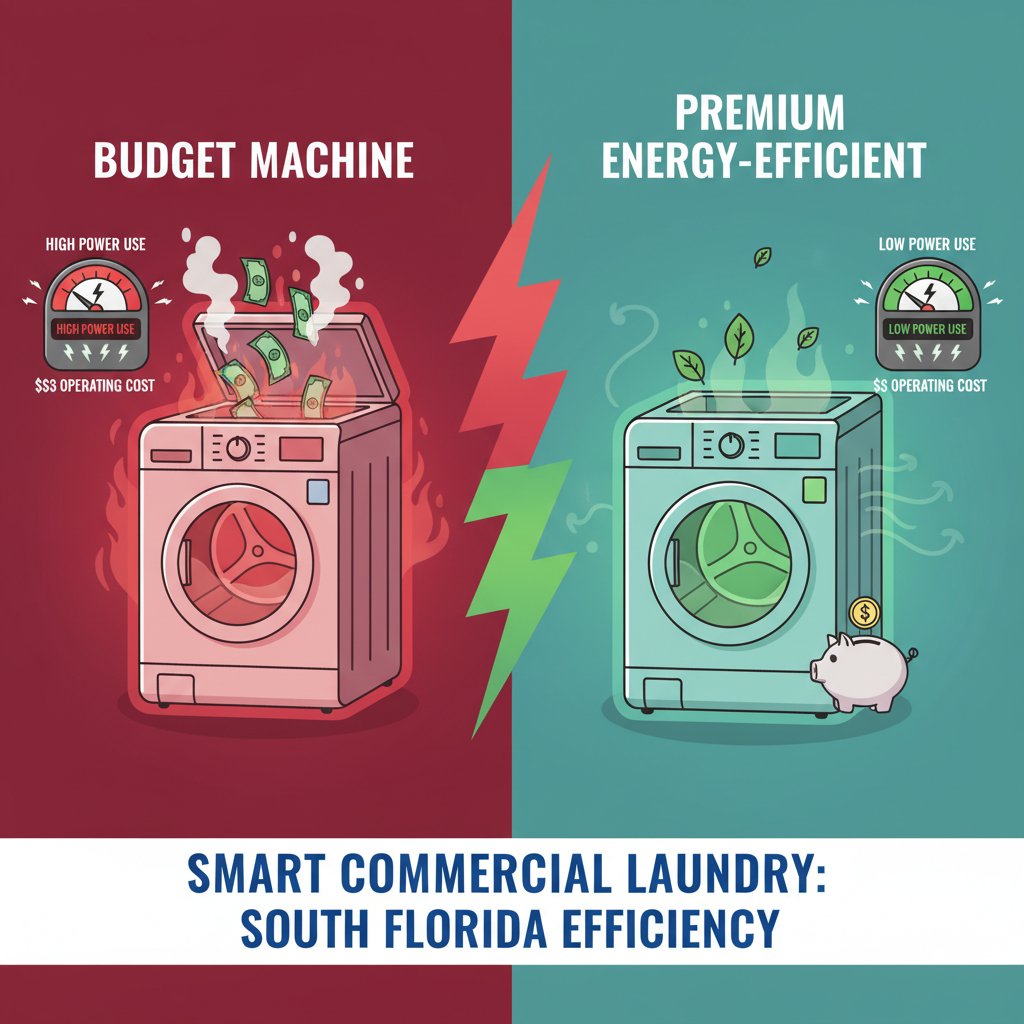
Budget commercial laundry equipment typically lacks the engineering sophistication that drives energy efficiency. These machines consume significantly more electricity and gas than their quality counterparts, creating ongoing operational expenses that accumulate month after month.
Lower-grade commercial washers often feature weak extract speeds, measured in G-force. When a washer can’t spin out moisture effectively during the final cycle, dryers must work longer and harder to finish the job. A quality commercial washer with 200+ G-force extraction removes substantially more water than budget models spinning at 100 G-force or less.
The math becomes clear quickly: if your dryers run an extra 10-15 minutes per load because washers leave clothes soaking wet, those additional minutes translate to hundreds of dollars monthly in natural gas or electric costs. Multiply this across dozens of daily loads in a hotel, hospital, or busy laundromat, and the commercial laundry equipment costs spiral upward dramatically.
According to the Department of Energy, commercial laundry operations represent one of the largest energy expenses for hospitality and healthcare facilities. Choosing inefficient equipment magnifies this expense unnecessarily.
2. Frequent Repairs and Downtime
Cheap commercial laundry equipment breaks down more frequently. This isn’t opinion—it’s engineering reality. Manufacturers cut costs somewhere, and those cuts typically happen in components you can’t see: bearings, seals, pump quality, motor construction, and control board specifications.
Each breakdown carries multiple costs. First, there’s the repair bill itself. Budget equipment often uses proprietary or non-standard parts that cost more and take longer to source. Second, there’s the revenue lost during downtime. A broken washer in a laundromat means lost income. A broken machine in a hotel means either sending laundry out (expensive) or disappointing guests with towel shortages (worse).
Perhaps most frustrating is the cumulative time spent managing repairs. Facility managers don’t budget for the hours spent calling service companies, waiting for technicians, following up on parts orders, and explaining the same problem to different service providers. This administrative burden has real costs, even when it doesn’t appear on invoices.
Quality commercial equipment from established manufacturers typically requires fewer service calls and experiences longer intervals between component replacements. The commercial laundry investment in better equipment pays dividends through reliability.
3. Water Waste and Higher Utility Bills
Older technology and budget-focused designs typically mean poor water efficiency. Commercial washers without proper water level controls, efficient spray rinse systems, or modern fill algorithms use substantially more water per pound of laundry.
South Florida water and sewer rates continue rising, making efficiency increasingly important. A commercial washer that uses 4 gallons per pound versus one using 2 gallons per pound doubles your water costs for that equipment. Processing 1,000 pounds of laundry daily, that difference means an extra 2,000 gallons daily—over 60,000 gallons monthly.
Beyond the direct water costs, there’s also the sewage expense. Most municipalities charge sewer fees based on water consumption. Inefficient equipment therefore hits you twice: once for the incoming water and again for the outgoing wastewater.
Hot water consumption presents another concern. Budget equipment often lacks sophisticated temperature controls, leading to excessive hot water use even when it isn’t necessary for the wash program being run. Heating water represents a significant portion of commercial laundry equipment costs in ongoing operations.
4. Shortened Equipment Lifespan
Commercial laundry equipment represents a significant capital investment. The expected lifespan of that equipment directly impacts your laundry equipment ROI calculations.
Quality commercial washers and dryers often deliver 15-20 years of reliable service with proper maintenance. Budget equipment frequently begins experiencing major component failures within 5-7 years, requiring either expensive rebuilds or complete replacement.
Consider the real numbers: if quality equipment costs $8,000 and lasts 18 years, your annual capital cost is approximately $445. If budget equipment costs $4,500 but lasts only 6 years, your annual capital cost is $750. The “cheap” option costs nearly 70% more annually when accounting for lifespan.
This calculation doesn’t even include the higher repair costs and energy consumption the budget equipment generates along the way. The true total cost of ownership laundry equipment becomes clear only when analyzing the complete picture over realistic timeframes.
5. Limited or Unavailable OEM Parts
Budget commercial laundry equipment often comes from manufacturers with limited U.S. presence or distribution networks. When components fail, finding genuine OEM replacement parts becomes challenging or impossible.
This creates several problems. Generic replacement parts may not meet original specifications, leading to poor performance or additional failures. Waiting for parts shipped from overseas means extended downtime. In some cases, parts simply aren’t available anymore, forcing premature equipment replacement.
Established commercial laundry manufacturers maintain extensive parts inventories and dealer networks. When a bearing fails or a control board malfunctions, authorized service providers can typically source OEM parts within days or even hours. This responsiveness keeps your operation running and revenue flowing.
The parts availability issue becomes especially critical for businesses dependent on their laundry equipment. A hotel can’t tell guests to wait two weeks for towels. A healthcare facility can’t postpone sanitation. A laundromat loses customers to competitors every day equipment sits broken. Access to reliable parts availability carries tremendous value that initial commercial washer prices don’t reflect.
6. Poor Extraction and Extended Cycle Times
Time equals money in commercial laundry operations. Budget equipment typically processes loads more slowly than quality alternatives, reducing your throughput capacity.
Weak extract speeds represent a particular problem. As mentioned earlier, poor moisture removal forces dryers to run longer. But there’s another cost: you can’t start the next wash load until the current one finishes. A commercial washer that takes 35 minutes per cycle versus one completing cycles in 28 minutes means fewer loads processed daily.
For laundromats, this limits revenue potential. Your building has finite hours each day. Equipment that processes 20% fewer loads means 20% less revenue from the same square footage and operating hours.
For on-premise laundries in hotels, hospitals, or multi-housing facilities, slow equipment creates staffing challenges. Employees wait for machines rather than maintaining productive workflow. Overtime may be required to complete necessary laundry volumes. Labor costs increase while productivity decreases.
Modern commercial equipment offers programmable controls, optimized wash cycles, and high-speed extraction that maximize throughput without sacrificing cleaning quality. These features directly impact operational efficiency and commercial laundry investment returns.
7. Inadequate Service and Support Network
The cheapest commercial laundry equipment often comes from manufacturers or distributors without established service infrastructure. When problems arise—and they will—finding qualified technicians familiar with your specific equipment becomes difficult.
This manifests in several ways. Service calls take longer to schedule because fewer technicians work on that equipment brand. Repairs take longer because technicians aren’t familiar with the systems. Problems may not get fixed correctly the first time, requiring multiple visits.
Some businesses discover their equipment provider has gone out of business entirely, leaving them with orphaned machines and no factory support. Others find that the “authorized service” promised at purchase time consists of one technician operating from a residential address two counties away.
Factory-authorized service networks provide training, technical support, diagnostic tools, and parts access that independent repair people can’t match. This professional support infrastructure keeps equipment running efficiently and maximizes lifespan. When evaluating commercial laundry equipment costs, the strength of the service network behind that equipment deserves serious consideration.
South Florida’s commercial laundry service landscape includes providers with decades of local presence and manufacturers with national reputations. These established relationships matter when equipment problems interrupt your business operations at the worst possible moment.
Calculating True Commercial Laundry Investment Value
Smart purchasing decisions require looking at total cost of ownership rather than sticker prices. Create a realistic analysis including these factors:
- Purchase price: The initial equipment cost
- Installation costs: Delivery, positioning, utility connections, and any building modifications required
- Energy consumption: Estimated monthly electricity, gas, and water costs based on manufacturer specifications and your expected usage
- Maintenance expenses: Anticipated service calls, routine maintenance, and component replacements over the equipment lifespan
- Expected lifespan: How many years the equipment will reliably operate before requiring replacement
- Downtime costs: Revenue lost or additional expenses incurred when equipment breaks down
- Productivity impact: How cycle times and throughput affect your labor costs and revenue generation
This comprehensive evaluation reveals the true laundry equipment ROI. Equipment that costs 40% more initially but lasts twice as long while using 30% less energy and requiring half the repairs represents superior value.
Questions to Ask Before Purchasing
Protect your commercial laundry investment by asking equipment providers these essential questions:
About the Equipment
- What is the G-force extraction rating?
- What energy efficiency certifications does this equipment hold?
- What is the expected lifespan with normal commercial use?
- What programmable options and cycle customization does it offer?
- How does water consumption compare to other models in this capacity range?
About Service and Support
- Is your company a factory-authorized distributor for this brand?
- Where is your nearest service location?
- What is your average response time for service calls?
- Do you stock OEM parts locally or must they be ordered?
- How many technicians on your team are trained on this specific equipment?
- What warranty coverage is included, and what extended warranty options exist?
About Total Costs
- What are the estimated annual energy costs for this equipment at my expected volume?
- What maintenance schedule does the manufacturer recommend?
- What components typically need replacement and at what intervals?
- Can you provide references from similar businesses using this equipment?
Equipment providers confident in their products welcome these questions and provide detailed answers. Evasive responses or pressure to focus only on purchase price should raise concerns.
Making the Right Choice for Your Operation
Commercial laundry equipment serves your business for years or decades. This long-term relationship means purchase decisions ripple through your operations and finances far into the future.
The lowest commercial washer prices rarely deliver the best value. Instead, focus on finding equipment properly sized for your volume, engineered for efficiency, backed by reliable service, and built to last. Work with established distributors who maintain local service presence and factory authorizations ensuring access to expertise and genuine parts.
Your specific situation determines the right equipment choice. A 200-room hotel has different needs than a 50-unit apartment building or a 3,000-square-foot laundromat. Proper sizing, appropriate features, and realistic total cost of ownership calculations guide you toward equipment that supports your business goals rather than undermining them.
The hidden costs of cheap commercial laundry equipment aren’t really hidden—they simply reveal themselves over time through utility bills, repair invoices, lost revenue, and operational frustrations. By understanding these costs upfront, you can make informed decisions that protect your investment and support long-term success.
Need help evaluating commercial laundry equipment for your South Florida facility? Our team brings over 55 years of experience helping businesses select, install, and service commercial laundry systems. We provide honest assessments, detailed cost analyses, and factory-authorized service that keeps your equipment running efficiently for years. Contact us today to discuss your specific requirements and discover equipment solutions that deliver real value beyond the price tag.