
Commercial dryers fail at alarming rates in South Florida—not because the equipment is defective, but because humidity creates operational conditions that most facility managers don’t fully understand. When ambient moisture levels regularly exceed 70%, commercial laundry equipment faces challenges that simply don’t exist in drier climates. The result? Longer cycle times, higher energy costs, premature component failures, and frustrated customers wondering why their industrial-grade dryers can’t keep up with demand.
Understanding why commercial dryer problems intensify in humid climates isn’t just about troubleshooting breakdowns—it’s about making smarter purchasing decisions, implementing proper maintenance protocols, and designing ventilation systems that account for South Florida’s unique environmental conditions.
How Humidity Affects Commercial Dryer Performance
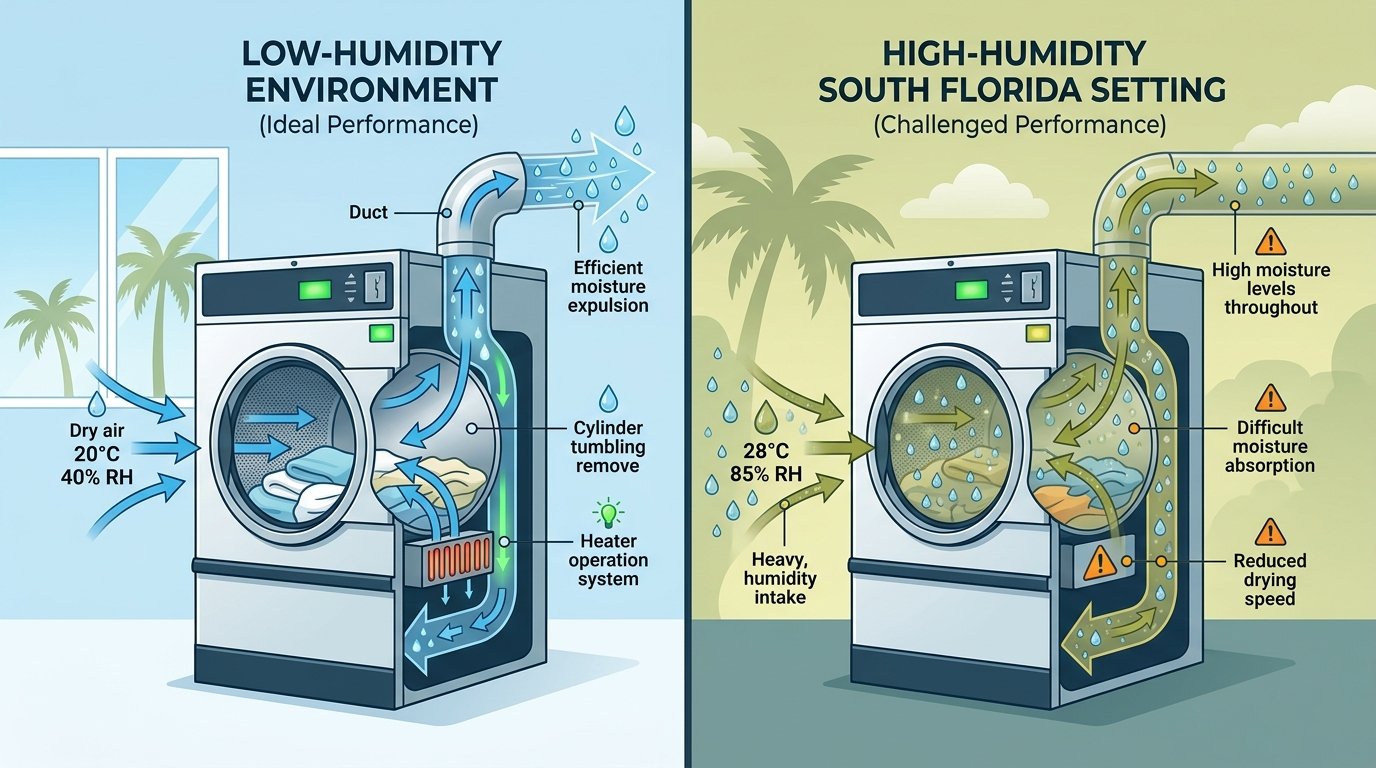
Commercial dryers remove moisture from fabrics by heating air, passing it through tumbling textiles, and exhausting that moisture-laden air outside. In low-humidity environments, this process works efficiently because the air entering the dryer starts relatively dry. In South Florida, incoming air already carries substantial moisture content, fundamentally changing the thermodynamic equation.
When a dryer pulls in air at 75°F with 80% relative humidity, that air contains significantly more water vapor than the same temperature air at 30% humidity. The heating element must work harder and longer to raise the air temperature to effective drying levels, then that heated air has reduced capacity to absorb additional moisture from wet linens. This creates a cascading effect throughout the entire drying process.
Extended Cycle Times and Energy Waste
The most immediate impact facility managers notice is longer drying cycles. A load that takes 28 minutes in Phoenix might require 40-45 minutes in Fort Lauderdale during summer months. This isn’t a machine defect—it’s physics. The dryer is compensating for humid intake air by running longer to achieve the same dryness levels.
Extended cycles mean higher natural gas or electric consumption per load. For high-volume operations processing 500+ pounds daily, this translates to thousands of dollars annually in unnecessary energy costs. Hotels running continuous laundry operations and multi-housing facilities with vended equipment see the impact directly on utility bills and equipment availability.
Ventilation Problems in Humid Climates
Commercial dryer ventilation becomes critically important when operating commercial laundry South Florida locations. Many dryer failures attributed to “mechanical problems” are actually ventilation issues exacerbated by humidity.
Moisture-heavy exhaust air condenses more readily in ductwork, especially when that ductwork runs through air-conditioned spaces or encounters cooler surfaces. This condensation accumulates as lint-trapping moisture, creating restrictions that reduce airflow. Restricted airflow forces dryers to work harder, increases internal temperatures, and triggers thermal safety switches that shut down equipment.
Lint Accumulation Accelerates
Humid exhaust carries lint differently than dry exhaust. The moisture causes lint particles to clump and adhere to duct walls rather than flowing freely to the exterior termination. Over months, these accumulations create partial blockages that gradually degrade dryer performance.
Facility managers often don’t recognize the gradual degradation. Dryers that once completed cycles in 30 minutes now take 38 minutes, then 42 minutes. Staff assumes loads are wetter or the dryer is aging, when the actual problem is restricted ventilation caused by humidity-enhanced lint buildup.
Component Failures Linked to Moisture
High humidity doesn’t just affect drying performance—it accelerates wear on critical components, leading to premature failures that create unexpected downtime and repair costs.
Heating Element Deterioration
Gas burners and electric heating elements cycle more frequently in humid conditions because the dryer works harder to maintain target temperatures. Increased cycling means more thermal stress and faster degradation. Electric elements experience oxidation at connection points when exposed to humid air infiltration, creating resistance that generates heat and eventual failure.
Moisture Control Sensors
Modern commercial dryers use moisture-sensing technology to automatically terminate cycles when fabrics reach desired dryness levels. These sensors—typically metal bars or strips inside the drum—detect conductivity changes as moisture decreases. In humid environments, moisture in the ambient air can interfere with sensor accuracy, causing premature cycle termination that leaves loads damp or extended cycles that waste energy.
Sensor calibration requires more frequent attention in South Florida than in drier regions. What works perfectly in January may require adjustment by June when humidity climbs.
Motor and Belt Stress
Extended run times mean dryer motors and drive belts accumulate more operating hours per load. A facility processing the same volume as a comparable operation in Denver will log significantly more motor hours annually. Bearings wear faster, belts stretch and crack sooner, and motors overheat more frequently—all traceable to humidity-driven extended cycles.
Why Proper Equipment Sizing Matters More in Humidity
Undersized commercial dryers struggle everywhere, but humid climate laundry equipment faces amplified consequences. A dryer operating at 90% capacity in Colorado might handle the load adequately, but that same utilization rate in Miami creates chronic problems.
When dryers run continuously at maximum capacity in humid conditions, they never get the cool-down time needed to manage moisture accumulation in ventilation systems. Ductwork stays warm and moisture-saturated, accelerating lint adhesion. Equipment runs hotter overall, stressing components designed for intermittent operation.
Proper sizing means selecting dryer capacity that accounts for both load volume and environmental conditions. A 75-pound dryer might be theoretically sufficient for your volume, but a 120-pound dryer running at moderate capacity will perform more reliably and last longer in South Florida’s humidity.
Maintenance Requirements Increase
Effective dryer maintenance in humid climates requires more frequent attention to specific systems:
- Lint trap cleaning: Multiple times daily for high-volume operations, not just once per shift
- Duct inspection: Quarterly rather than annually, with professional cleaning when moisture-related buildup appears
- Sensor calibration: Checked seasonally as humidity levels change throughout the year
- Exterior vent terminations: Inspected for proper damper operation and pest intrusion that blocks airflow
- Burner assemblies: Annual inspection for gas dryers, checking for moisture-related corrosion
Many commercial dryer problems in South Florida facilities trace back to maintenance schedules designed for different climates. Following manufacturer recommendations based on national averages leaves equipment under-maintained for local conditions.
Installation Considerations for Humid Environments
Proper installation dramatically impacts long-term dryer reliability in humid climates. Several factors deserve special attention:
Ventilation Design
Ductwork should be as short and straight as possible, with rigid metal construction rather than flexible ducting that traps moisture and lint. Every 90-degree elbow reduces airflow and creates condensation points. When longer duct runs are unavoidable, slight upward pitch toward the exterior termination helps moisture drain outward rather than pooling in low spots.
Exterior terminations need proper dampers that prevent humid outside air from infiltrating ductwork during dryer downtime. Without functional dampers, South Florida’s outdoor humidity migrates into ventilation systems, depositing moisture that promotes lint adhesion even when equipment isn’t running.
Make-Up Air Requirements
Commercial dryers exhaust thousands of cubic feet per minute. That air must be replaced from somewhere. In tightly-constructed modern buildings, insufficient make-up air creates negative pressure that restricts dryer exhaust, forcing equipment to work harder and run longer.
Make-up air systems in humid climates should incorporate basic filtration to reduce incoming moisture when possible. While not always feasible, even simple measures like drawing make-up air from air-conditioned spaces rather than directly from outdoors can reduce the humidity burden on dryers.
Choosing Equipment Built for Humid Climates
Not all commercial dryers handle humidity equally well. When specifying equipment for South Florida installations, several features indicate better humid-climate performance:
- Higher airflow capacity: Models that move more CFM can process humid air more effectively
- Robust heating capacity: Oversized heating elements provide headroom for humid conditions
- Stainless steel construction: Reduces corrosion in moisture-rich environments
- Advanced moisture sensing: Better algorithms that compensate for ambient humidity
- Commercial-grade components: Designed for extended run times that humid climates demand
Factory-authorized dealers familiar with South Florida conditions can recommend specific models and configurations proven in local installations. A commercial laundry partner with regional service experience understands which equipment delivers reliable performance rather than simply meeting specification sheets.
When to Consider Dehumidification
Large commercial laundry operations sometimes benefit from laundry room dehumidification systems. While adding upfront cost, dedicated dehumidification can pay dividends through faster cycle times, reduced energy consumption, and extended equipment life.
Dehumidification makes most sense for enclosed laundry rooms processing high volumes continuously—hotels, hospitals, large multi-housing facilities with on-premise laundries. The investment becomes harder to justify for smaller operations, but the calculation changes when factoring total cost of ownership including energy and maintenance savings.
The Service Partnership Advantage
Humidity-related commercial dryer problems often develop gradually, making them difficult for in-house staff to identify before they create serious issues. A qualified service partnership provides preventive maintenance that catches moisture-related deterioration early.
Technicians experienced with South Florida commercial laundry installations recognize humidity-specific problems that generalist repair services miss. They understand that sensor recalibration isn’t addressing a defect—it’s normal maintenance for this climate. They know which ductwork configurations create condensation problems and can recommend corrections before minor restrictions become major failures.
Service providers with OEM factory authorization and parts availability minimize downtime when components do fail. When a motor bearing fails on Saturday afternoon, having a service partner with proper parts inventory and technicians familiar with your specific equipment model means repairs in hours rather than days.
Moving Forward with Humid-Climate Strategies
Commercial dryer reliability in South Florida requires acknowledging that humidity fundamentally changes equipment performance and longevity. Facilities that implement humidity-aware equipment selection, installation practices, and maintenance protocols experience fewer failures, lower operating costs, and better return on investment.
Whether you’re evaluating new equipment, troubleshooting performance issues, or planning facility upgrades, factoring humidity into every decision improves outcomes. The commercial laundry equipment that works perfectly in Atlanta needs adjustment for Fort Lauderdale—not because it’s inadequate, but because the operating environment demands different approaches.
If your commercial dryers are underperforming, running extended cycles, or requiring frequent repairs, humidity is likely contributing to the problems. A thorough assessment of your ventilation system, maintenance protocols, and equipment specifications can identify improvements that restore performance and reduce operational costs. Contact a commercial laundry equipment specialist with South Florida experience to evaluate your specific situation and develop solutions matched to your facility’s needs and our region’s challenging humidity conditions.