

Apartment communities across South Florida are losing residents over something entirely preventable: unreliable laundry facilities. According to research from the National Multifamily Housing Council, in-unit or on-site laundry consistently ranks among the top five amenities influencing rental decisions. When your laundry room is out of order, residents don’t just get frustrated—they look for a new address at renewal time.
For property managers and apartment owners across Palm Beach, Broward, and Miami-Dade counties, this creates a straightforward business case: the right multi-housing laundry equipment isn’t an expense. It’s an asset that directly affects occupancy rates, resident retention, and net operating income.
Why Laundry Facilities Drive Resident Decisions
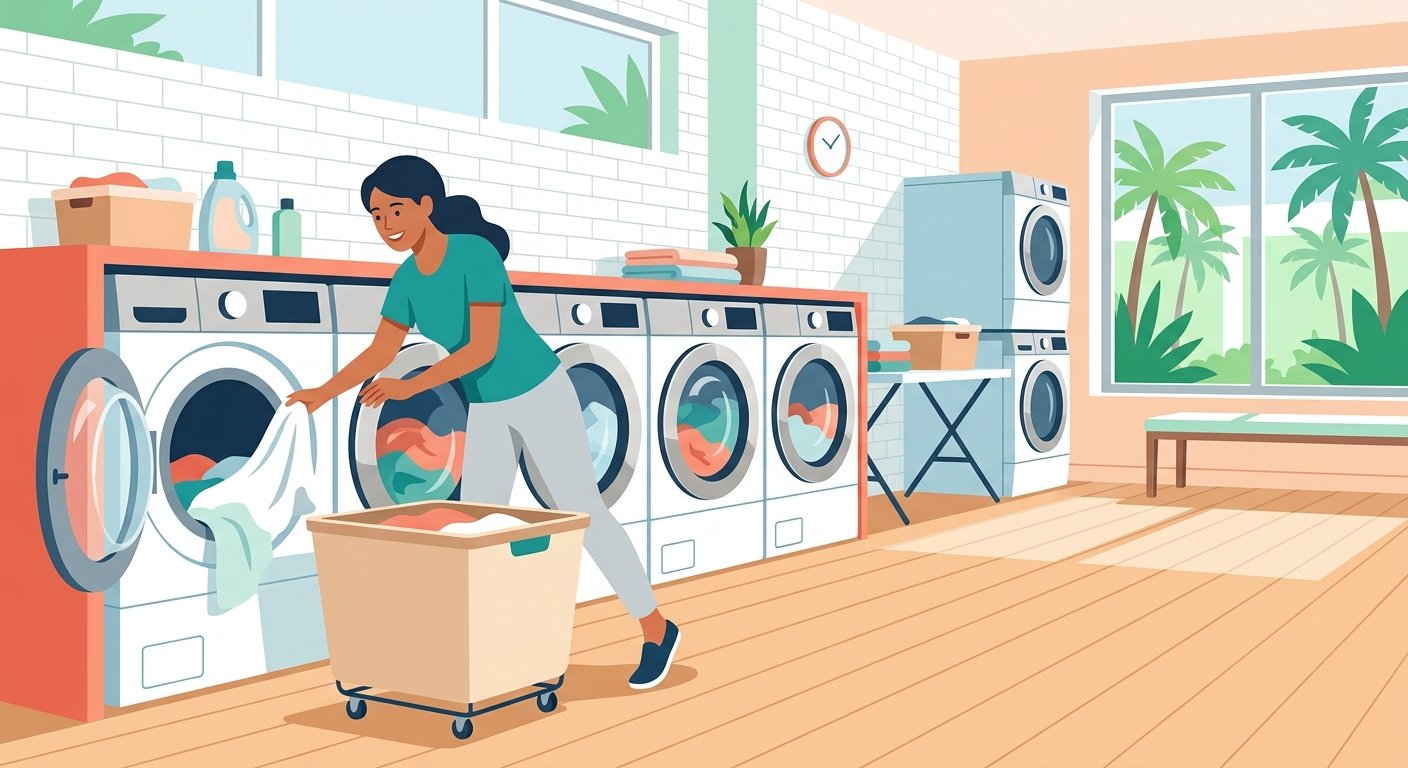
Modern renters treat laundry access as a baseline expectation, not a luxury. This is especially true in South Florida’s competitive multi-housing market, where residents at all price points have options. A building with functional, clean, well-maintained laundry facilities signals that management cares about the property. A building with broken machines, damp odors, and hand-written “Out of Order” signs signals the opposite.
The connection to retention is measurable. When a resident moves out, you’re looking at unit turnover costs—cleaning, repainting, vacancy days, leasing fees—that can easily run into the thousands of dollars per unit. If just one or two lease renewals per year are tied to laundry satisfaction, your equipment investment has already justified itself.
Choosing the Right Commercial Laundry Machines
Not all commercial laundry equipment is sized or configured the same way, and property managers who treat apartment laundry like a commodity purchase tend to run into problems quickly. The right equipment selection depends on your building’s resident count, usage patterns, space constraints, and utility connections.
Capacity and Load Planning
Undersizing is one of the most common and costly mistakes in multi-housing laundry installations. When machines run at maximum capacity around the clock without adequate equipment to absorb demand, you get accelerated wear, resident frustration, and chronic maintenance calls. A general planning guideline is one washer-dryer pair per 10 to 12 units, but South Florida buildings with year-round occupancy and no seasonal vacancy patterns often need to plan at the higher end of that range.
Commercial washer extractors in the 18 to 40-pound capacity range are the workhorses of most apartment laundry rooms. These machines are built for shared-use environments—they cycle more frequently, handle mixed loads from different users, and need to hold up without daily oversight the way on-premise laundry (OPL) equipment in a hotel or hospital might receive.
Hardmount vs. Softmount Considerations
For multi-housing applications, softmount washer extractors offer meaningful advantages. Softmount machines use internal suspension systems to absorb vibration during high-speed extraction cycles, which means they don’t require concrete anchoring and generate less structural vibration in multi-story buildings. If your laundry room is on an upper floor or in a wood-frame structure, a softmount machine with a high G-force extraction rating can reduce dry time significantly—lowering energy costs and keeping residents moving through the room faster.
Hardmount machines remain effective in ground-floor slab installations where anchoring is straightforward, but the conversation about which is appropriate for your building is worth having with a knowledgeable equipment provider before purchase, not after installation.
Vended vs. Common-Area Laundry: Which Model Fits Your Property?
Property owners sometimes assume that common-area laundry—free to residents and bundled into rent—is the default choice. But the vended laundry model, where residents pay per cycle, has real advantages worth considering.
Common-area (rent-inclusive) laundry:
- Simplicity for residents—no coins or apps required
- Can be positioned as a premium amenity to justify higher rents
- Operational costs absorbed by the property
- Often preferred in higher-end communities where the perception of “free” amenities adds marketing value
Vended laundry:
- Generates direct revenue to offset equipment, utility, and maintenance costs
- Modern card-based and mobile payment systems remove the friction of coin-only machines
- Can partially or fully self-fund the laundry operation over time
- Revenue data helps you track utilization and plan equipment upgrades
Many South Florida multi-housing properties are shifting toward card-operated or app-enabled payment systems. These not only improve the resident experience but give property managers usage analytics that inform maintenance scheduling and future capacity planning.
The True Cost of Deferred Maintenance
One of the clearest patterns we’ve seen across 55+ years of serving South Florida properties is that deferred maintenance on laundry equipment costs far more than proactive service. A machine that’s running rough for three months before a motor fails isn’t just a repair bill—it’s weeks of resident complaints, potential lease terminations, and the emergency scramble to source parts and schedule service during peak usage periods.
Commercial laundry machines in apartment environments run hard. Depending on building size, a single washer might complete 10 to 20 cycles per day, meaning annual cycle counts that far exceed what residential machines ever face. Preventive maintenance programs—lubricating bearings, inspecting door seals, checking electrical connections, cleaning lint traps and drain paths—extend equipment life and protect the resident experience simultaneously.
This is one of the core reasons working with a factory-authorized service provider matters. Factory authorization means access to OEM parts, current technical training, and manufacturer-backed support that extends equipment life and maintains warranty coverage. The U.S. Department of Energy’s guidelines on commercial laundry equipment also highlight that properly maintained equipment performs closer to rated efficiency specifications—which translates directly to lower utility costs per cycle.
Energy Efficiency and South Florida Utility Costs
South Florida properties pay attention to utility costs, and laundry rooms are a meaningful line item. Modern commercial washer extractors with high-speed extraction—at or above 200 G-force—remove significantly more water mechanically before garments enter the dryer. Less moisture means shorter dry cycles, lower gas or electric consumption, and higher throughput during peak evening hours when residents are competing for machines.
ENERGY STAR-certified commercial laundry machines are worth specifying when building ROI models. The ENERGY STAR program’s commercial clothes washer specifications provide standardized efficiency metrics that allow direct comparisons between equipment models—useful when presenting capital expenditure justifications to ownership groups or HOA boards.
Beyond the machines themselves, hot water heater sizing and dryer venting layout affect operational efficiency. Undersized water heaters create wash temperature inconsistency; improperly designed dryer venting creates fire risk and dramatically increases dry times. These are system-level considerations that a qualified commercial laundry equipment installer should evaluate as part of any new installation or major renovation.
What Residents Actually Notice
Beyond equipment specs, residents evaluate laundry facilities through a practical lens:
- Availability: Are there enough machines to avoid long waits during peak hours?
- Reliability: Are the machines consistently operational, or is there always one out of service?
- Cleanliness: Is the room maintained? Do machines smell clean?
- Payment convenience: Can they pay with a phone or card, or are they hunting for quarters?
- Cycle time: Are wash and dry cycles completing in a reasonable time?
Every one of these factors is a function of equipment selection, capacity planning, and maintenance—decisions made before residents ever walk into the room. Getting them right reduces complaints, reduces turnover, and reduces the operational headache of managing a chronically underperforming amenity.
Frequently Asked Questions
How many washers and dryers does an apartment building need?
A common starting guideline is one washer-dryer pair per 10 to 12 units. However, South Florida properties with high year-round occupancy or demographics that favor on-site laundry should plan toward the lower end of that ratio. An experienced commercial laundry equipment provider can analyze your building’s specific profile and recommend a configuration based on actual usage patterns rather than general averages.
What’s the difference between commercial and residential laundry machines for apartments?
Commercial laundry machines are engineered for continuous shared use—higher cycle counts, more durable components, and designs that accommodate varied loads from multiple users. Residential machines installed in shared-use environments wear out rapidly, void warranty coverage, and create ongoing repair and replacement costs that exceed the initial savings. For any multi-unit property, commercial washer extractors are the appropriate and cost-effective choice.
Should apartment laundry be vended or free to residents?
Both models work, and the right choice depends on your property’s positioning and operational structure. Vended systems with modern card or mobile payment options can generate revenue that offsets equipment and utility costs. Free laundry can support higher rental rates and positions as a premium amenity. Many properties find vended laundry with a clean, well-maintained room more than satisfactory for resident retention goals.
How long should commercial apartment laundry equipment last?
Quality commercial laundry equipment in a well-maintained multi-housing installation typically has a service life of 10 to 15 years or more. Factors like cycle volume, water quality, and the consistency of preventive maintenance significantly influence equipment longevity. Working with a factory-authorized service provider and using OEM replacement parts protects both equipment life and warranty coverage.
What payment systems work best for apartment laundry rooms?
Card-based and mobile app-enabled payment systems have largely replaced coin-only machines in modern multi-housing laundry rooms. These systems reduce friction for residents, lower the risk of vandalism associated with coin vaults, and provide management with usage data. Many current commercial laundry machine platforms integrate directly with payment management software, simplifying operations for on-site staff.
Partnering for the Long Term
The laundry room is a small footprint on a property map but a disproportionately large factor in resident satisfaction and retention. For South Florida apartment owners and property managers across Palm Beach, Broward, and Miami-Dade counties, getting the equipment right the first time—correct sizing, appropriate machine type, modern payment systems, and a service plan that keeps everything running—is a fundamentally different decision than buying the cheapest machines available and hoping for the best.
As a second-generation, family-owned business that has been serving South Florida’s multi-housing sector for over 55 years, Commercial Laundry Equipment Company helps property managers and owners evaluate their specific situation, select the right equipment, and establish service relationships that protect the investment long after installation day. We’re factory-authorized for the brands we sell, and our local service presence means we’re not shipping parts from a warehouse across the country when something needs attention.
If you’re evaluating your property’s laundry facilities—whether it’s a new installation, equipment replacement, or a renovation—contact us at (561) 848-0054 or visit our commercial laundry equipment page to learn more about how we can help.