
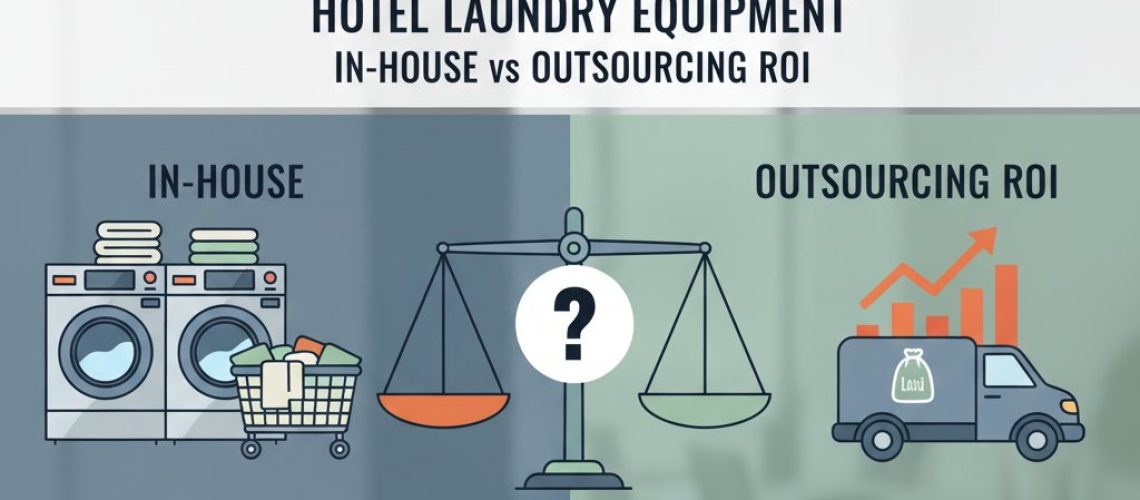
Hotel operators face a crucial decision that impacts both guest satisfaction and bottom-line profitability: should you invest in commercial laundry equipment for hotels and bring linen processing in-house, or continue outsourcing to third-party services? The answer isn’t universal, but the financial implications are substantial. A 150-room property typically processes 40,000 to 60,000 pounds of laundry monthly, and the cost difference between managing this in-house versus outsourcing can reach six figures annually.
Understanding the true return on investment requires looking beyond simple per-pound pricing to examine hidden costs, operational control, quality consistency, and long-term strategic benefits. Many South Florida hoteliers discover that what initially appears as a significant capital expense transforms into a profit center within 18 to 36 months.
The Real Cost of Outsourcing Laundry Services
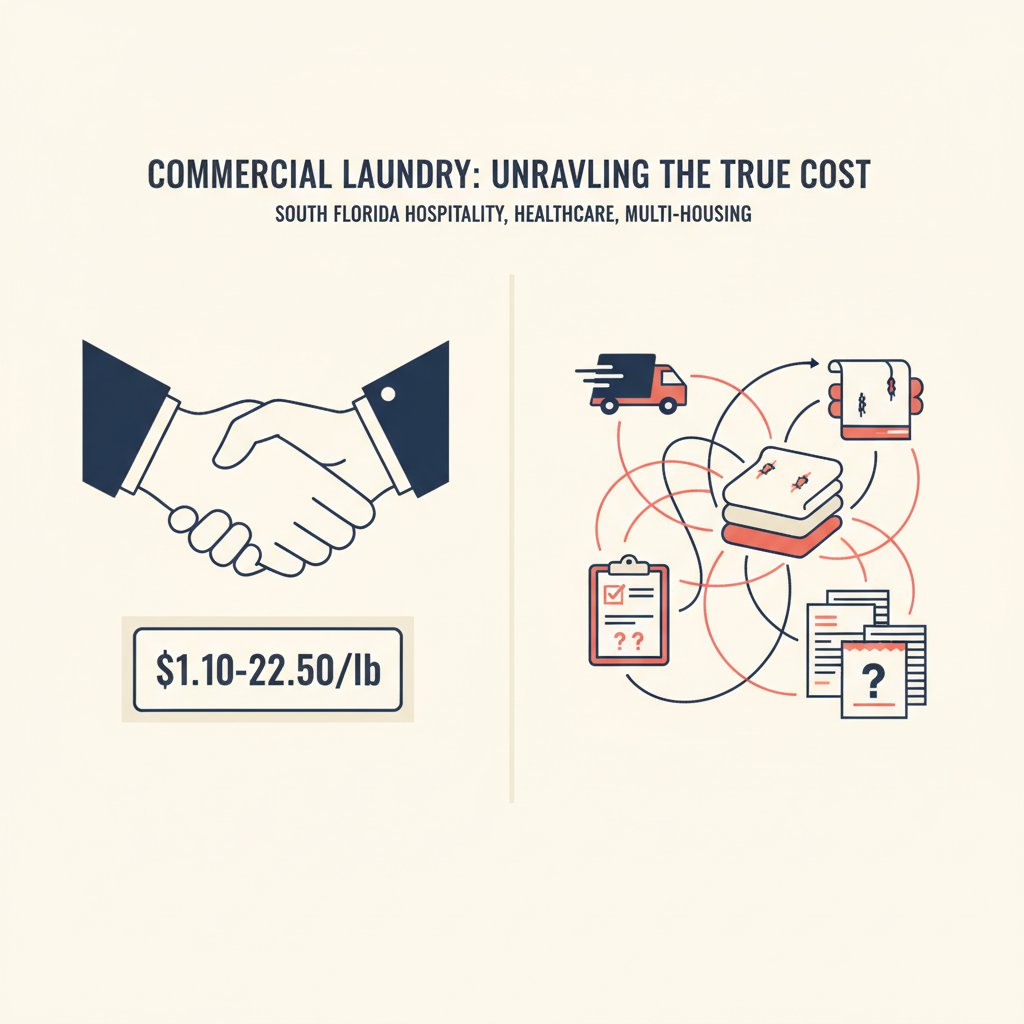
Outsourcing hotel laundry appears deceptively simple: sign a contract, and linens get picked up dirty and returned clean. However, the actual costs extend well beyond the per-pound rate on your monthly invoice.
Commercial laundry services typically charge between $1.10 and $2.50 per pound depending on volume, geographic location, and service level agreements. For a 150-room hotel with 75% occupancy, this translates to $4,400 to $10,000 monthly, or $52,800 to $120,000 annually. These rates often include escalation clauses tied to inflation or energy costs, reducing budget predictability.
Beyond direct processing fees, outsourcing creates several hidden expenses:
- Linen inventory multiplication: Hotels must maintain 3 to 5 par levels instead of 2 to 3 when processing in-house, as linens spend days in transit and processing queues. This requires 50-60% more initial linen investment.
- Replacement acceleration: Industrial laundry services process multiple client loads using standardized cycles that may not optimize for your specific linen quality. Aggressive processing reduces textile lifespan by 20-30%.
- Service interruptions: Delivery delays, incorrect counts, or quality issues require staff time for reconciliation and guest service recovery.
- Lost operational flexibility: Last-minute events, unexpected occupancy spikes, or VIP requests become logistical challenges when you don’t control your laundry cycle.
Many hotel operators also overlook the environmental cost. Third-party services transport dirty and clean linens across South Florida daily, adding carbon footprint that increasingly matters to guests and corporate sustainability commitments.
In-House Hotel Laundry Equipment Investment Analysis
Establishing an on-premise laundry (OPL) requires upfront capital investment, but the financial equation often favors ownership when examined over a realistic timeline. The initial investment for hospitality laundry solutions varies significantly based on hotel size and throughput requirements.
A comprehensive hotel laundry room installation for a 100 to 150-room property typically includes:
- Commercial washer-extractors (60-80 lb capacity): $15,000-$35,000 per machine
- Commercial dryers (120-170 lb capacity): $12,000-$28,000 per unit
- Folder or small ironer for flatwork: $8,000-$45,000
- Installation, utility connections, and code compliance: $10,000-$25,000
Total equipment investment ranges from $70,000 to $180,000 depending on capacity, automation level, and whether you select hardmount or softmount machines. Commercial laundry equipment financing options make this accessible, with qualified buyers securing favorable terms that align payments with operational savings.
Operational Cost Comparison
Once installed, hotel commercial washing machines and dryers operate at dramatically lower per-pound costs than outsourced services. Direct processing expenses include:
Utilities: Modern high-efficiency equipment processes linens for approximately $0.12-$0.25 per pound in combined water, electricity, and gas costs. Machines with high G-force extraction (300-400 G’s) remove more water during the spin cycle, reducing drying time and energy consumption by 30-50% compared to lower-extraction models.
Labor: A 150-room hotel typically requires 1.5 to 2.5 full-time equivalent positions for laundry operations, costing $45,000-$75,000 annually including benefits. This represents $0.15-$0.25 per pound when processing 40,000-50,000 pounds monthly.
Chemistry and supplies: Commercial detergents, softeners, and sanitizers add approximately $0.08-$0.15 per pound.
Maintenance: Preventive maintenance and repairs average $0.03-$0.06 per pound with proper equipment selection and service partnerships. Factory-authorized service using OEM parts significantly impacts this calculation—equipment maintained properly operates 15-20 years versus 8-12 years without proper service.
Total in-house processing costs range from $0.38 to $0.71 per pound compared to outsourcing at $1.10 to $2.50 per pound. For a property processing 50,000 pounds monthly, this represents $19,500 to $89,500 in annual savings.
Break-Even Timeline and ROI Calculation
Simple payback analysis divides total equipment investment by annual operational savings. Using the 150-room hotel example with $100,000 equipment investment and conservative $40,000 annual savings, the break-even point arrives at 2.5 years. More aggressive scenarios with higher occupancy or premium outsourcing rates show 12-18 month payback periods.
However, comprehensive ROI analysis must account for additional financial benefits:
Reduced linen replacement costs: Controlled washing processes tailored to your specific textiles extend linen life by 25-40%. For properties spending $30,000-$50,000 annually on linen replacement, this represents $7,500-$20,000 in additional savings.
Inventory reduction: Decreasing par levels from 4-5 to 2.5-3 releases $40,000-$80,000 in working capital for a typical property.
Revenue protection: Immediate access to clean linens eliminates checkout delays and enables housekeeping efficiency that supports higher RevPAR. Properties with in-house laundry report 15-20% faster room turnover during high-occupancy periods.
Quality consistency: Direct control over wash processes, water temperature, chemical concentrations, and handling ensures consistent presentation quality that supports brand standards and guest satisfaction scores.
When these factors combine, true ROI frequently exceeds 40-60% annually after the initial payback period, with equipment continuing to generate value for 12-20 years with proper maintenance.
Critical Factors That Influence the Decision
Property Size and Occupancy
Hotel size creates natural decision thresholds. Properties under 75 rooms often struggle to justify dedicated laundry staff and equipment, though select-service hotels with limited food and beverage operations and standard linen programs sometimes succeed at smaller scales. Properties exceeding 100 rooms with reasonable occupancy almost universally benefit from in-house operations. The 75-100 room range requires detailed financial modeling based on specific operational characteristics.
Available Space and Infrastructure
South Florida properties, particularly in dense urban markets like Miami Beach or Fort Lauderdale, face space constraints that impact feasibility. A functional hotel laundry requires 400-800 square feet minimum, with larger properties needing 1,000-1,500 square feet. The space must accommodate proper equipment layout, working areas for sorting and folding, and adequate ventilation.
Infrastructure requirements include 220-240V three-phase electrical service, natural gas or steam supply for dryers, adequate water supply (60+ GPM for larger operations), properly sized drainage, and robust HVAC to manage heat and humidity. Older buildings may require electrical panel upgrades or gas service installation, adding $15,000-$40,000 to project costs.
Service and Maintenance Considerations
Commercial laundry equipment for hotels represents sophisticated mechanical systems requiring professional service. Hotels without access to factory-authorized local service providers face extended downtime, expensive emergency service calls, and reduced equipment lifespan. South Florida’s competitive hospitality market demands reliable operations—laundry equipment failures that delay checkouts or compromise linen quality directly impact guest satisfaction and revenue.
Establishing relationships with service providers before equipment selection ensures parts availability and rapid response. Equipment brands with strong regional support networks and readily available OEM parts minimize operational risk.
Labor Market and Management
In-house laundry operations require hiring, training, and supervising dedicated staff. South Florida’s competitive labor market and minimum wage increases affect operational costs. Hotels must evaluate whether management has bandwidth to oversee another department or if the operational complexity outweighs financial benefits.
Successful operations implement clear productivity standards (typically 40-60 pounds processed per labor hour), quality control checkpoints, and safety protocols. Properties that view laundry as simply “adding a washing machine” frequently struggle with efficiency and quality issues that erode financial benefits.
Hybrid Approaches and Strategic Alternatives
The decision need not be binary. Many hotels implement hybrid models that optimize both control and efficiency:
Partial outsourcing: Process terry (towels and robes) in-house while outsourcing flatwork (sheets, pillowcases, tablecloths) to commercial laundries with high-speed ironers. Terry represents 60-70% of weight but requires less finishing equipment.
Peak support: Maintain in-house capacity for normal operations while contracting backup services during peak seasons or special events.
Phased implementation: Start with basic washing and drying, outsourcing only finishing, then add folding equipment as volume justifies investment.
These approaches reduce initial capital requirements while capturing significant cost savings and operational control.
Frequently Asked Questions
How long does hotel laundry equipment last?
Commercial-grade hotel commercial washing machines and dryers typically operate 12-20 years with proper maintenance. Equipment longevity depends heavily on installation quality, regular preventive maintenance, water quality management, and proper operation. Machines serviced by factory-authorized technicians using OEM parts consistently reach the upper end of this range.
What financing options exist for hotel laundry equipment?
Commercial laundry equipment financing includes traditional equipment loans, operating leases, capital leases, and manufacturer financing programs. Qualified buyers often secure terms from 36-84 months with competitive rates. Financing converts large capital expenditures into predictable monthly payments that align with operational savings, improving cash flow during implementation.
Can small hotels justify in-house laundry?
Properties with 75-100 rooms can justify in-house operations when occupancy exceeds 65-70% consistently, space is available without displacement of revenue-generating areas, and management can effectively supervise operations. Below 75 rooms, financial justification becomes challenging unless the property has unique circumstances like remote location, specialized linen requirements, or existing underutilized space and staff.
How do you size commercial laundry equipment for hotels?
Proper sizing considers occupied rooms, linen par levels, processing schedule, and peak demand periods. General guidance suggests 60-80 lb washer capacity and 120-170 lb dryer capacity for every 75-100 occupied rooms when processing daily. Undersizing creates operational bottlenecks, while oversizing wastes capital and reduces efficiency. Professional assessments ensure optimal equipment selection for specific operational requirements.
Making the Right Decision for Your Property
The in-house versus outsourcing decision deserves thorough financial analysis customized to your property’s specific circumstances. Most South Florida hotels with 100+ rooms and available space discover compelling ROI favoring equipment investment, particularly when evaluating 5-10 year horizons rather than focusing solely on immediate costs.
Start by accurately calculating your current total outsourcing costs including direct fees, extra inventory requirements, replacement acceleration, and hidden operational impacts. Then develop realistic projections for in-house operations including equipment investment, installation, utilities, labor, supplies, and maintenance. Factor in financing costs, tax implications, and strategic benefits like quality control and operational flexibility.
Engage experienced partners who understand hospitality laundry solutions and can provide honest assessments rather than simply selling equipment. The right decision balances financial returns with operational capabilities, space realities, and long-term strategic goals. With proper planning, equipment selection, and service support, in-house hotel laundry operations transform from cost centers into profit generators that enhance both guest satisfaction and financial performance.
Ready to explore whether in-house laundry makes sense for your property? Contact our team for a customized ROI analysis based on your specific operational characteristics, space availability, and business objectives. We’ll help you make an informed decision backed by financial clarity and 55+ years of hospitality laundry expertise in South Florida.