
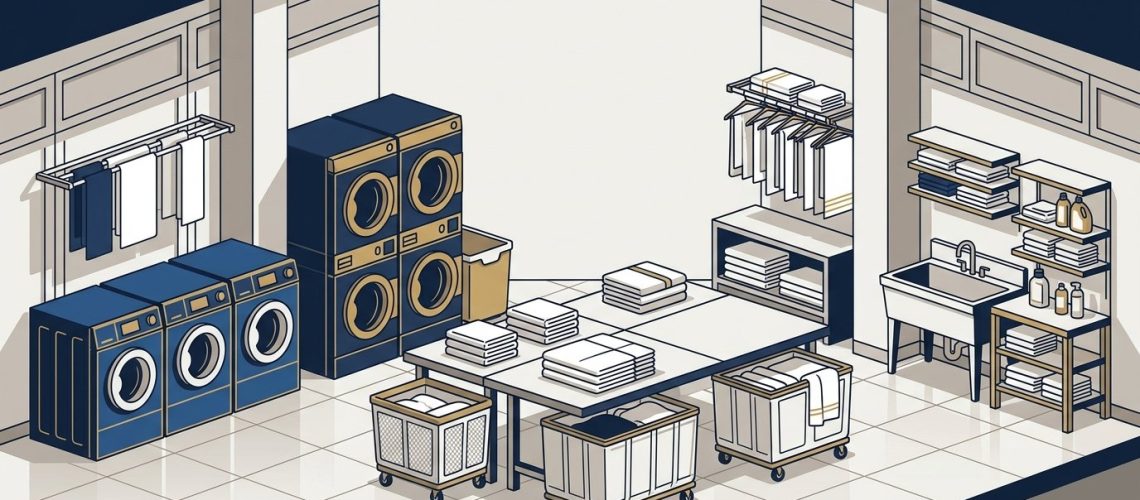
A hotel that processes linens and towels in-house operates on a different level of efficiency than one relying on outside linen services—but only if the laundry room is set up correctly from the start. Miss a piece of equipment, undersize a washer, or skip proper utility planning, and what should be a productivity asset becomes a bottleneck that affects every department from housekeeping to guest satisfaction.
This checklist walks through the essential components of a properly configured hotel on premise laundry (OPL) room, with guidance drawn from over 55 years of working with South Florida hospitality properties. Whether you’re building from scratch, replacing aging equipment, or renovating an existing facility, this is your starting point.
Why Hotel On Premise Laundry Makes Sense
Running your own laundry operation gives hotel management direct control over linen quality, turnaround times, and long-term costs. For properties in Miami, Fort Lauderdale, Boca Raton, and the greater Palm Beach area, where occupancy rates can run high year-round and linen standards matter to guests, that control is a competitive advantage.
According to the American Hotel & Lodging Association, linen and laundry management is consistently ranked among the top operational cost drivers for hotels. An efficient OPL reduces dependency on contract linen services, which carry markup and variable pricing. The tradeoff is investment in equipment, utilities, and trained staff—costs that are manageable when the room is properly designed from day one.
If you’re evaluating whether OPL is right for your property, our hotel laundry equipment overview provides a solid foundation before diving into the setup specifics here.
The Core Equipment Checklist
1. Commercial Washers (Hardmount or Softmount)
This is the centerpiece of any hotel laundry room. The choice between hardmount and softmount washers affects your floor, your utility costs, and your throughput.
- Hardmount washers are bolted to the floor and require a reinforced concrete slab. They’re durable, widely used, and available in capacities ranging from 18 lbs. to 135 lbs. per cycle. For hotels with existing reinforced slabs, hardmounts are often the practical choice.
- Softmount washers use internal suspension to absorb vibration, meaning they don’t require floor reinforcement. They also extract at higher G-force levels—often 200–400G compared to a hardmount’s typical 100G—which removes more water before drying. Less moisture going into the dryer means shorter dry times, lower energy use, and faster linen turnaround.
For most South Florida hotel properties, capacity should be sized to handle your peak occupancy linen load in no more than two to three cycles per shift. Undersizing here creates a cascading bottleneck that housekeeping will feel immediately.
2. Commercial Dryers
Dryer capacity must match your washer output. A common sizing mistake is pairing a high-capacity washer with a dryer that can’t keep up—the result is wet linen sitting in carts waiting for dryer availability.
- Match dryer cylinder volume to washer capacity. Generally, dryer capacity should be roughly twice the washer capacity by weight to allow for proper tumbling and airflow.
- Gas dryers typically offer faster recovery and lower operating costs in Florida, where natural gas is widely available and electricity costs have risen steadily.
- Look for moisture sensor controls, which stop the cycle when linens reach the target dryness rather than running on a fixed timer. This prevents over-drying, which degrades fabric faster and wastes energy.
3. High-G Extraction (if using tunnel or barrier washers)
Larger hotel properties—typically 150+ rooms—may benefit from a tunnel washer or barrier washer system paired with a high-G extractor. These systems handle continuous volume more efficiently than batch washing, and a high-G centrifugal extractor can remove water down to 45–50% moisture retention before the linen ever enters the dryer.
This is advanced territory. If your property is at this scale, equipment sizing and layout planning require a site assessment before purchasing. Our team at Commercial Laundry Equipment Company works through these configurations regularly for larger South Florida hospitality clients.
4. Folding Equipment and Flatwork Ironers
For hotels with high sheet and tablecloth volumes, a flatwork ironer (also called a flatwork finisher) dramatically improves linen presentation and reduces labor time compared to hand folding. Small to mid-size models fit properties processing several hundred pounds of flatwork per day. Larger properties may require a two-roll or three-roll ironer.
Automatic folding attachments can be added to many ironer models, further reducing labor requirements and producing consistently folded linens that stack cleanly on housekeeping carts.
5. Utility Connections and Infrastructure
Equipment is only part of the setup. Your laundry room requires properly sized infrastructure, and this is where under-planning causes expensive problems after installation:
- Hot and cold water supply: Sized to support simultaneous washer fill cycles. Undersized supply lines reduce fill rates and extend cycle times.
- Drain capacity: Commercial washers discharge significant water volume quickly. Floor drains must handle this without backing up.
- Gas lines (if applicable): Sized for peak simultaneous dryer load. This requires coordination with your utility provider and a licensed plumber.
- Electrical service: Modern commercial laundry equipment often runs on 208V or 240V three-phase service. Confirm your building’s electrical panel capacity before equipment selection.
- Ventilation: Dryer exhaust must vent properly to the exterior. In South Florida’s humidity, inadequate ventilation creates moisture problems in the laundry space and affects dryer efficiency.
These infrastructure elements should be evaluated by licensed contractors before finalizing your equipment list. CLEC coordinates with contractors during hotel laundry equipment installation projects to ensure the equipment plan aligns with your building’s systems.
6. Chemical Dispensing Systems
Manual chemical dosing is inconsistent and wastes product. Automatic dispensing systems inject the correct amount of detergent, bleach, sour, and softener at the right point in each wash cycle. This protects linen quality, reduces chemical waste, and ensures consistent results across staff shifts.
Most commercial washers have dispensing ports compatible with standard chemical injection systems. Your chemical supplier typically provides and services dispensing equipment as part of a supply agreement.
7. Linen Carts and Sorting Equipment
Workflow in a hotel laundry room depends on how soiled and clean linens move through the space. This includes:
- Soiled linen carts for transport from floors to the laundry room
- Sorting tables or bins for separating sheets, towels, and F&B linens before washing
- Clean linen transport carts for delivery back to housekeeping storage
Cart and sorting equipment selection affects labor efficiency and cross-contamination prevention, particularly important for properties with food and beverage operations.
Sizing Your Equipment to Your Property
The most consistent mistake we see in hotel laundry room planning is equipment sized to average occupancy rather than peak occupancy. A hotel running at 90% occupancy during season needs laundry capacity built for that load, not for the off-season average.
Industry guidance from the ENERGY STAR Commercial Laundry program recommends equipment selection based on daily linen poundage calculations, factoring in linen reuse programs and F&B volume. A standard estimate for hotels is 12–15 lbs. of laundry per occupied room per day, but properties with restaurants, spas, or pools often run significantly higher.
We help South Florida hotel operators work through these calculations before any equipment is specified. Proper sizing upfront prevents the expensive mistake of buying equipment that either can’t handle peak load or sits underutilized most of the year.
Frequently Asked Questions
What is hotel on premise laundry (OPL)?
Hotel on premise laundry refers to an in-house laundry operation where the property owns and operates its own commercial washing and drying equipment rather than outsourcing to a commercial linen service. OPL gives hotels direct control over linen quality, turnaround time, and long-term operating costs.
How much space does a hotel laundry room need?
Space requirements depend on the number of rooms, linen volume, and equipment configuration. A 50-room property might operate with 400–600 square feet, while a 200+ room property may need 1,500 square feet or more, including space for equipment, carts, sorting, and chemical storage. Equipment layout also affects aisle clearance and workflow efficiency—these details matter and should be planned before purchase.
What’s the difference between hardmount and softmount washers for hotels?
Hardmount washers are anchored to reinforced concrete floors and extract water at lower G-force levels. Softmount washers use internal suspension, don’t require floor reinforcement, and extract at much higher G-force levels, reducing moisture before drying. For hotels focused on energy efficiency and linen turnaround speed, softmount equipment often delivers better long-term performance. See our commercial laundry equipment guide for more detail on this comparison.
How often does hotel laundry equipment need service?
Preventive maintenance intervals vary by manufacturer and usage intensity, but commercial hotel washers and dryers typically require inspection and service every 1,000–1,500 operating hours or at scheduled intervals. High-volume operations in South Florida should have a service agreement with a factory-authorized provider who stocks local parts. Waiting for a breakdown in peak season is far more costly than scheduled maintenance.
Can I use Speed Queen equipment for a hotel laundry room?
Yes. Speed Queen manufactures a full line of commercial OPL equipment well-suited to hotel laundry applications. CLEC is a factory-authorized Speed Queen commercial dealer serving South Florida. Learn more about available models through our Speed Queen commercial equipment page.
Work With a Local Expert Before You Specify Equipment
A hotel laundry room is a long-term operational investment. The decisions made at the planning stage—equipment capacity, washer type, dryer sizing, utility infrastructure—have consequences that play out over a decade or more of daily operation. Getting them right the first time matters far more than finding the lowest equipment price today.
Commercial Laundry Equipment Company has been helping South Florida hotels, from West Palm Beach down through Fort Lauderdale and Miami, build reliable hospitality laundry solutions for over 55 years. As a second-generation family-owned business with factory-authorized service capabilities and local parts availability, we’re positioned to support your operation long after installation day.
If you’re planning a new hotel laundry room or evaluating a renovation, reach out to our team at (561) 848-0054 to discuss your property’s specific needs. We’ll help you build an equipment plan that performs at peak occupancy, fits your space, and holds up for the long run.