
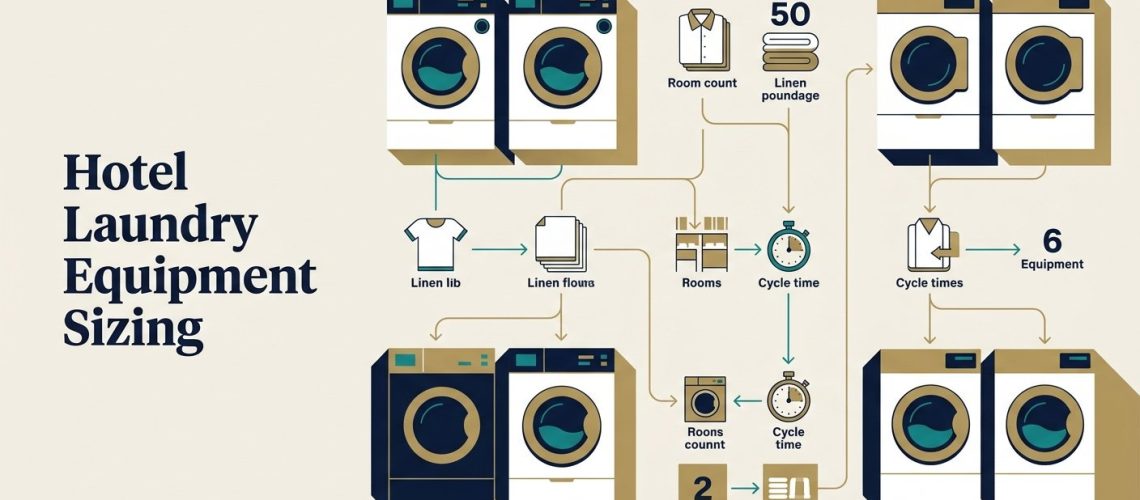
Sizing commercial laundry equipment for a hotel means matching machine capacity to your actual linen volume, not guessing or copying what a neighboring property uses. The right approach starts with calculating your daily linen weight, factoring in peak occupancy, and then working backward through cycle times to determine how many machines—and what size—you actually need. Undersizing causes backlogs and premature wear; oversizing wastes capital and utility costs.
- Start with linen poundage per room per day, then multiply by your peak occupancy rate to find your true daily load.
- Cycle time, not just machine capacity, determines throughput—a larger washer running slowly can process less linen than a smaller, faster unit.
- High-G-force extraction (300G+) significantly reduces dryer time and energy use, which matters especially in high-volume South Florida hospitality operations.
- Always design for peak demand, not average demand—a busy weekend or holiday surge will expose any undersizing immediately.
- Proper sizing requires a site-specific evaluation, including utility hookups, floor space, and drainage capacity.
Why Getting the Size Right Is So Important
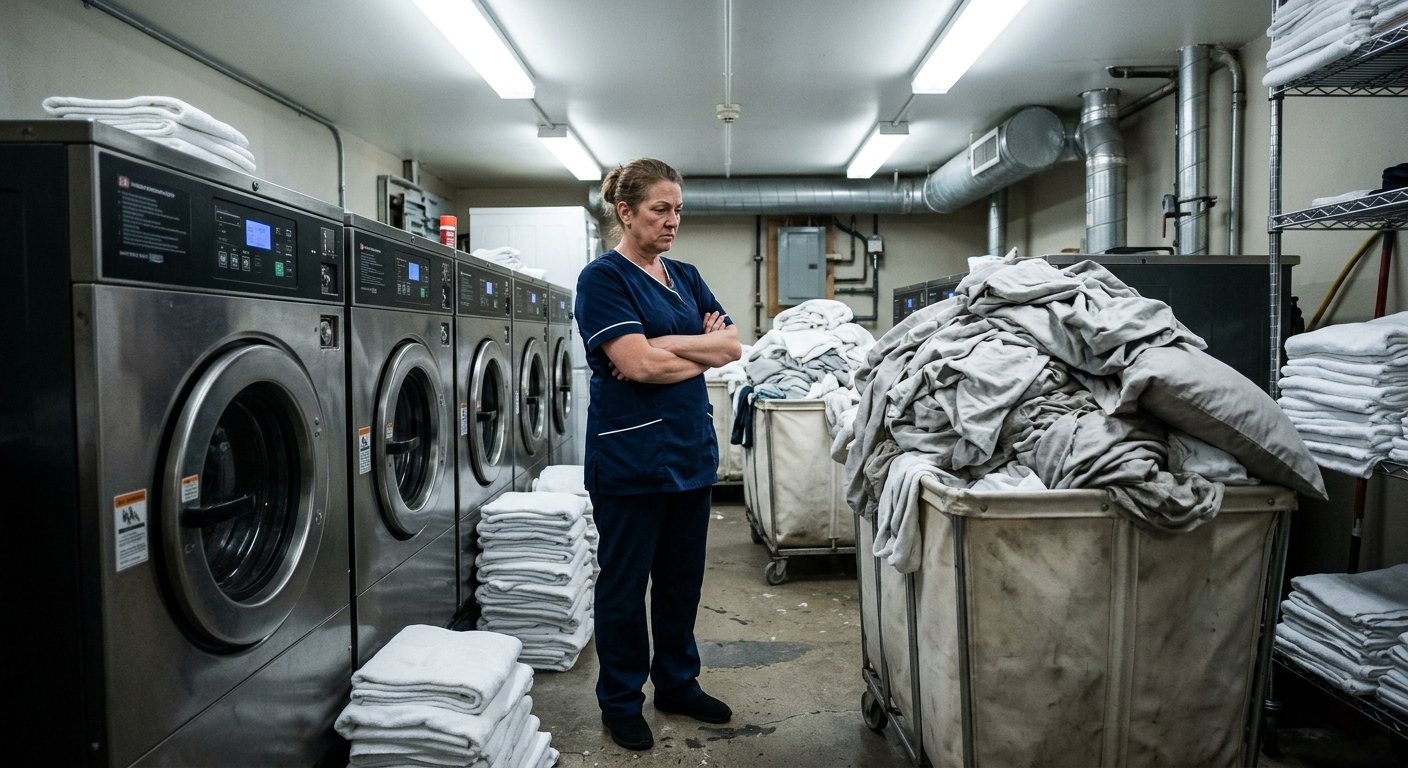
In a hotel laundry room, the cost of getting equipment sizing wrong isn’t abstract—it shows up as housekeeping delays, linen shortages, and frustrated guests. Overworked machines run hotter, wear faster, and fail sooner. A laundry room designed around average occupancy instead of peak demand will create a bottleneck precisely when you can least afford one: during a sold-out weekend, a holiday surge, or a group booking.
Conversely, oversizing carries its own problems. Machines that run partially loaded consume disproportionate water and energy per pound of linen processed, and large equipment may require utility or structural upgrades that weren’t budgeted. The goal is to find the configuration that handles your busiest realistic day with a manageable number of machines running at appropriate load levels.
South Florida’s hospitality market sees significant seasonal swings, with high season running roughly November through April. A property that’s 60% occupied in September may run at 95%+ during peak winter months. Your laundry system needs to handle the busiest days without becoming a liability during slower periods. This is one of the most common sizing challenges we help hotel operators work through.
Step 1: Calculate Your Daily Linen Poundage
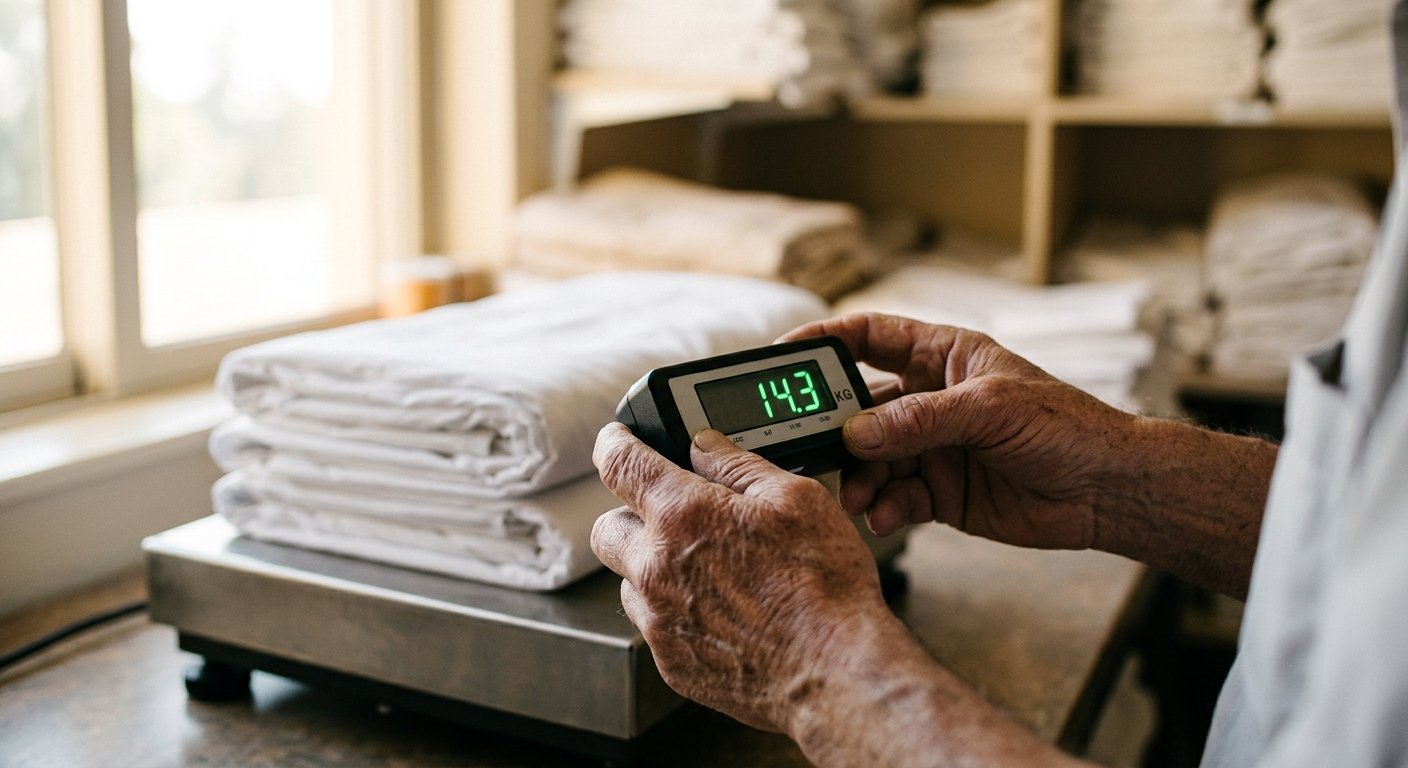
Every sizing calculation begins with a single number: how many pounds of linen does your hotel generate per occupied room, per day? This figure varies based on property type and service level, but the American Hotel & Lodging Association provides guidance that helps frame realistic estimates for different hotel categories. Rather than relying on industry averages alone, your best source is your own linen inventory—count the sheets, towels, pillowcases, and any food-and-beverage linens in your operation, then weigh a representative load.
For planning purposes, a typical full-service hotel room generates significantly more linen weight per night than a limited-service property, largely because of terry goods, robes, and multiple towel sets. Properties with restaurants, spas, or pools add food-and-beverage and pool towel volume on top of room linen. When in doubt, overestimate rather than underestimate—you can always run smaller loads, but you cannot process more linen than your machines can handle in a shift.
Inventory your linen types
List every linen category: bed sheets, pillowcases, duvet covers, bath towels, hand towels, washcloths, bath mats, robes, and any F&B or spa linens. Weigh a representative sample of each type when dry.
Calculate pounds per occupied room per day
Multiply the quantity of each linen type turned over daily by its dry weight. Sum these figures to get your per-room daily poundage. Multiply by your room count to find total daily linen volume at full occupancy.
Apply your peak occupancy rate
Use your highest realistic occupancy figure—typically your peak season average, not your absolute best single night. Designing for 90–95% occupancy is usually more practical than designing for 100%.
Factor in operational hours
Determine how many hours per day your laundry room will operate. Divide your total daily linen poundage by the number of operational hours to get the pounds-per-hour throughput your equipment must achieve.
Match throughput to machine configurations
Using manufacturer-published cycle times and rated capacities, calculate how many machines of what size are needed to hit your required pounds-per-hour. Always confirm these figures with a qualified equipment advisor.
Step 2: Understand Cycle Time and True Throughput
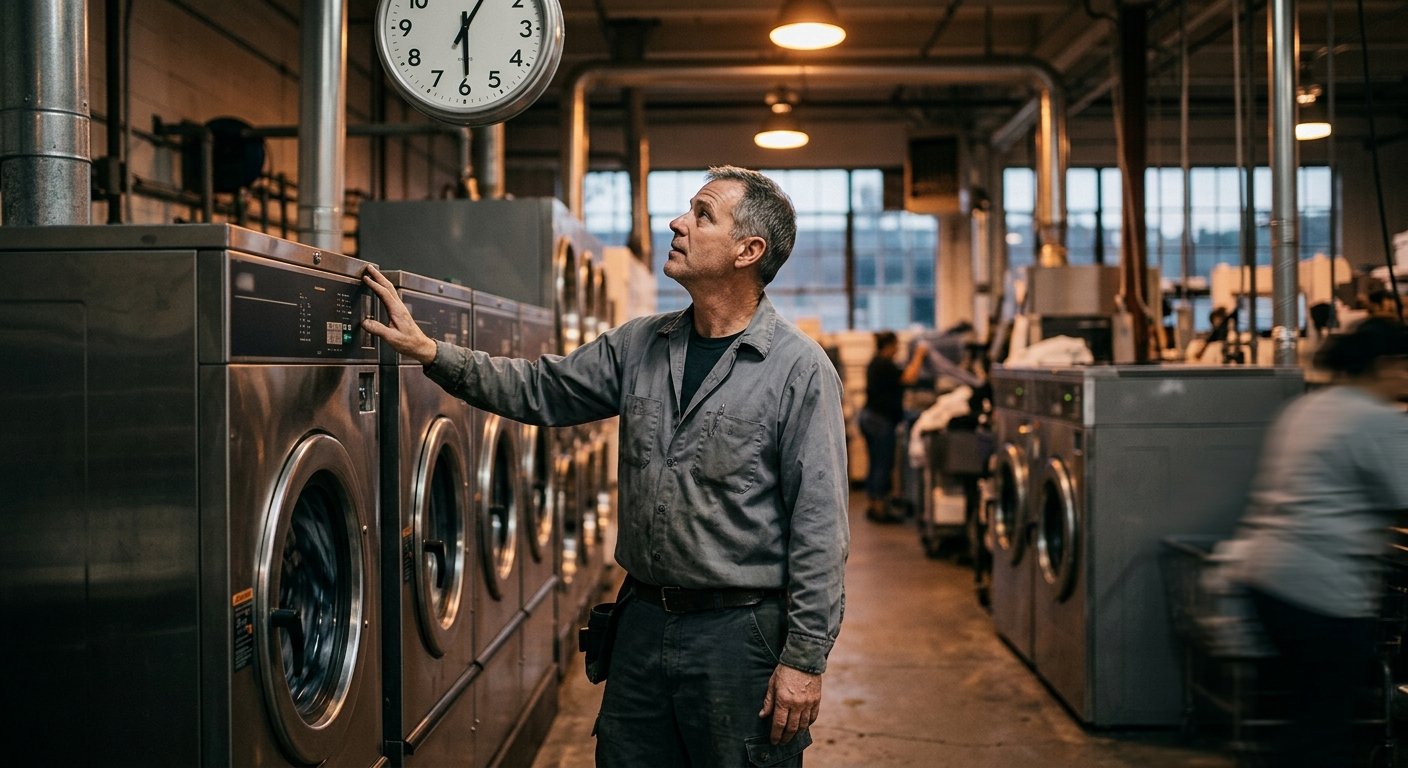
Machine capacity ratings—expressed in pounds—describe how much linen fits in the drum, not how much linen can be processed in an hour. True throughput depends on cycle time: a 60-pound washer with a 45-minute cycle processes roughly 80 pounds per hour, while the same machine with a 60-minute cycle processes only 60 pounds per hour. This distinction is critical when you’re trying to process a large linen volume within a defined shift window.
This is one reason high-G-force extraction matters so much in hotel on premise laundry operations. Machines with higher G-force ratings extract significantly more water from linen during the spin cycle, which shortens dryer time. If a washer’s cycle runs 45 minutes and dryer time drops from 45 minutes to 25 minutes due to better extraction, you’ve dramatically increased the throughput of your entire laundry room—not just the washer. For a detailed look at how washer capacity translates to real-world performance, understanding the interplay between drum size, load factor, and cycle time is essential before finalizing any equipment decision.
The washer capacity rating tells you what fits in the drum. Cycle time tells you how much linen you actually process in a shift—and that’s the number that runs your laundry room.
Hardmount vs. Softmount: What Hotel Operators Need to Know
One of the most consequential decisions in hotel laundry equipment sizing is choosing between hardmount and softmount washer-extractors. This choice affects not just performance, but installation requirements and where the equipment can be placed within your property.
| Factor | Hardmount Washers | Softmount Washers |
|---|---|---|
| Spin speed / G-force | Lower G-force (typically under 200G) | Higher G-force (300G–400G+) |
| Floor installation | Must be bolted to concrete slab | Can be installed on upper floors |
| Vibration transfer | Higher — requires structural support | Suspension system absorbs vibration |
| Water extraction | Good | Superior — shorter dryer times |
| Best application | Ground-floor laundry rooms with concrete slabs | Multi-story hotels, upper-floor installations |
For multi-story hotels in the Fort Lauderdale, Miami, and West Palm Beach markets, softmount machines are often the only practical option for upper-floor laundry rooms. The vibration isolation built into softmount designs protects the building structure and prevents the kind of noise and vibration transfer that would disturb guests. Our team at Commercial Laundry Equipment Company’s hotel laundry equipment page covers these installation considerations in more depth.
If your hotel laundry room is on an upper floor—even the second floor—always discuss structural requirements with a licensed engineer before equipment selection. A softmount washer-extractor is engineered to reduce vibration transfer, but the floor still needs to support the equipment weight. This is a conversation to have early in the planning process, not after equipment is ordered.
Dryer Sizing: The Overlooked Half of the Equation
Many hotel operators focus almost exclusively on washer capacity and then size dryers as an afterthought. This creates a common bottleneck: washers finish loads faster than dryers can process them, leaving wet linen sitting and housekeeping waiting. The general guidance in the industry is to pair dryer capacity at roughly 1.5 to 2 times the washer capacity to allow for the lower density of dried goods and to maintain throughput parity. The ENERGY STAR program for commercial clothes washers also provides efficiency benchmarks that can inform dryer pairing decisions and help estimate utility costs for your operation.
Gas dryers are typically more cost-effective to operate than electric in commercial settings, though the availability and cost of natural gas versus electric utility service at your specific South Florida property should factor into this decision. Condensation dryers, which don’t require external venting, can be useful in properties where ductwork runs are impractical—but they carry their own tradeoffs in heat output and cycle time.
Building a Configuration That Matches Your Property
Once you’ve calculated your required throughput, confirmed your floor type and utility availability, and decided on hardmount versus softmount, the next step is building a machine configuration. This typically means selecting a combination of washer sizes rather than relying on a single large machine. Running multiple mid-sized units gives you operational flexibility: if one machine goes down for service, you can continue processing linen while the repair is made. A single large washer with no backup creates a single point of failure that can shut down your entire laundry operation.
For hospitality laundry solutions that need to run reliably day in and day out, resilience matters as much as raw capacity. Explore the full range of commercial laundry equipment options available to find configurations that provide both throughput and operational redundancy.
Frequently Asked Questions
How many pounds of linen does a typical hotel room generate per day?
This varies significantly by property type and service level. Full-service properties with robes, multiple towel sets, and F&B operations generate more linen per room than limited-service hotels. The most accurate approach is to weigh your own linen inventory rather than rely on generic benchmarks, since your specific amenities and turnover practices determine the actual number.
Should hotel laundry equipment be hardmount or softmount?
The answer depends on where the laundry room is located within the building. Ground-floor rooms on concrete slabs can typically accommodate hardmount machines, which are generally less expensive. Upper-floor laundry rooms require softmount washers to control vibration and protect the building structure. A qualified commercial laundry equipment advisor can assess your space and make the appropriate recommendation.
How many dryers do I need per washer?
A common starting point is to pair dryer capacity at 1.5 to 2 times washer capacity, since dried linen occupies more drum space than wet linen. However, the exact ratio depends on your specific cycle times, extraction G-force, and linen types. Higher-G-force extraction removes more water, which shortens dryer time and can change the optimal dryer-to-washer ratio for your setup.
What happens if my hotel laundry equipment is undersized?
Undersized laundry rooms create a cascade of operational problems: housekeeping delays, linen shortages during peak occupancy, machines running continuously without cooling periods, and accelerated wear on equipment. These issues tend to become visible during your busiest periods—exactly when you need reliable throughput the most. Designing for peak demand rather than average demand prevents this scenario.
Do I need a different equipment configuration for a seasonal South Florida hotel?
Potentially, yes. South Florida properties with dramatic seasonal swings—high winter occupancy and lower summer volume—benefit from configurations that allow flexible operation. Multiple mid-sized machines rather than one large unit let you run fewer machines during slow periods, reducing wear and utility consumption, while bringing full capacity online during peak season.
Get a Sizing Evaluation for Your Hotel Laundry Room
Commercial Laundry Equipment Company has been helping South Florida hotels select, install, and service the right laundry equipment for over 55 years—reach out to start a conversation about your property’s specific needs.

About Commercial Laundry Equipment Company
Commercial Laundry Equipment Company is a second-generation, family-owned supplier and service provider specializing in commercial laundry equipment for South Florida's hospitality, healthcare, multi-housing, and laundromat sectors. With over 55 years of local experience, CLEC helps business owners and facility managers select, install, and maintain the right equipment for their specific needs—from hardmount washers and high-G extractors to complete OPL and vended laundry systems. Their approach emphasizes long-term value, proper sizing, factory-authorized parts, and responsive local service over lowest-price sales, making them a trusted partner for businesses that depend on reliable laundry operations. Visit commerciallaundryequip.com →